
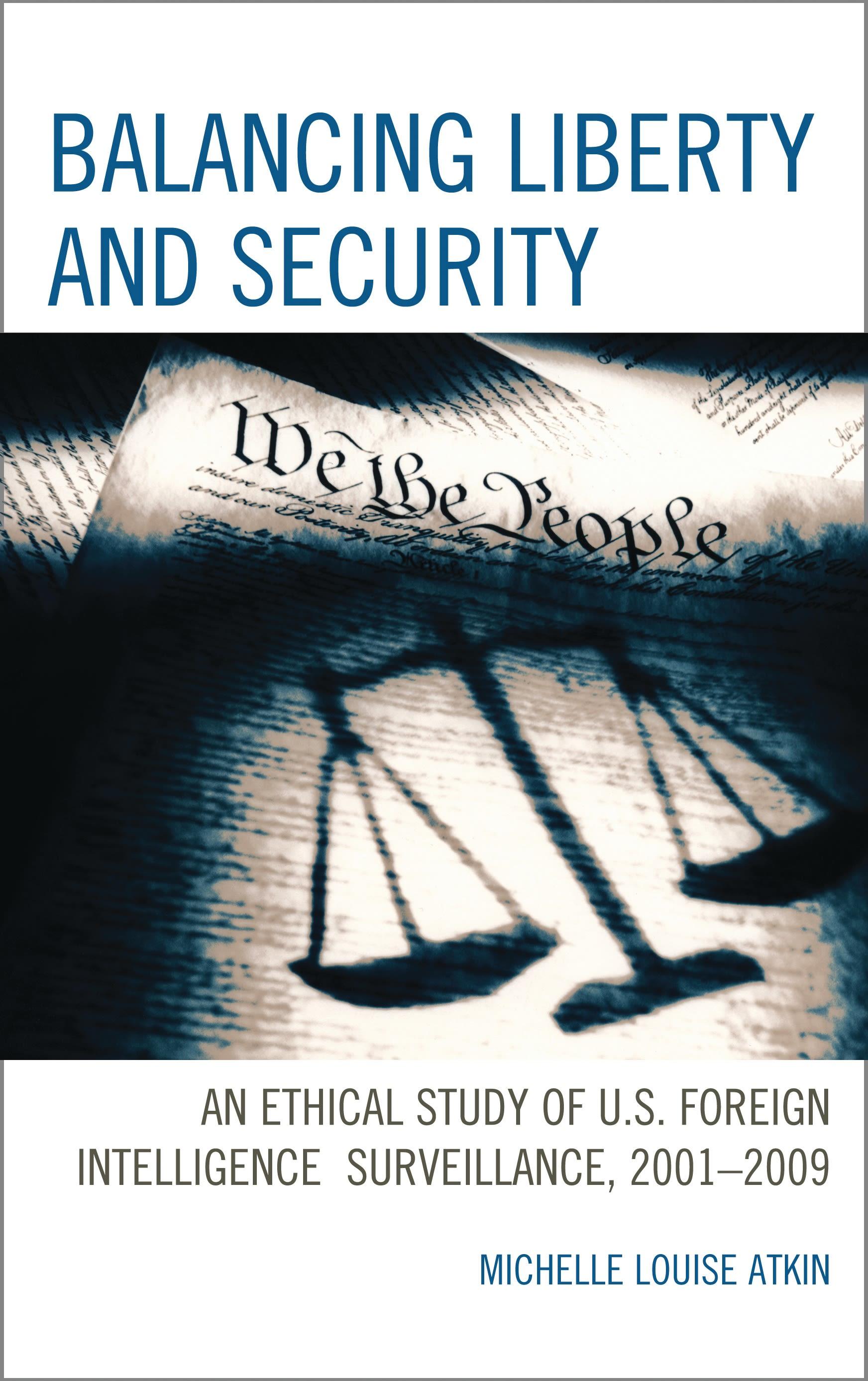
This work examines the philosophical foundations of information ethics and their potential for application to contemporary problems in U.S. foreign intelligence surveillance. Questions concerning the limits of government intrusion on protected Fourth Amendment rights are examined against the backdrop of the post-9/11 period. Changes to U.S. foreign intelligence surveillance law and policy are analyzed by applying the traditional ethical theories commonly used to support or discount these changes, namely utilitarian and contractarian ethical theories. The resulting research combines both theoretical elements, through its use of analytic philosophy, and qualitative research methods, through its use of legislation, court cases, news media, and scholarship surrounding U.S. foreign intelligence surveillance. Using the U.S.A. PATRIOT Act, the Foreign Intelligence Surveillance Act (FISA) and the Terrorist Surveillance Program as case examples, the author develops and applies a normative ethical framework based on a legal proportionality test that can be applied to future cases involving U.S. foreign intelligence surveillance.
The proportionality test developed in this research, which is based on a modified version of the Canadian Oakes Test, seeks to balance legitimate concerns about collective security against the rights of the individual. As a new synthesis of utilitarian and contractarian ethical principles, the proportionality test laid out in this book has potential for application beyond U.S. foreign intelligence surveillance. It could act as a guide to future research in other applied areas in information policy research where there is a clear tension between individual civil liberties and the collective good of society. Problems such as passenger screening, racial and ethnic profiling, data mining, and access to information could be examined using the framework developed in this study.
The proportionality test developed in this research, which is based on a modified version of the Canadian Oakes Test, seeks to balance legitimate concerns about collective security against the rights of the individual. As a new synthesis of utilitarian and contractarian ethical principles, the proportionality test laid out in this book has potential for application beyond U.S. foreign intelligence surveillance. It could act as a guide to future research in other applied areas in information policy research where there is a clear tension between individual civil liberties and the collective good of society. Problems such as passenger screening, racial and ethnic profiling, data mining, and access to information could be examined using the framework developed in this study.
Payez facilement par carte, Klarna, Apple Pay ou Google Pay. Pas satisfait ? Vous avez toujours une garantie de remboursement de 14 jours. En savoir plus dans nos conditions. Si vous avez des questions, envoyez-nous un e-mail à hello@memmo.org.
Memmo facilite tes études, où que tu sois dans le monde. On rassemble tes manuels de cours et des outils d'étude intelligents au même endroit : résumés, quiz, podcasts et flashcards. Et il y a Ted, ton compagnon d'étude qui répond à toutes tes questions. Plus de 50 000 étudiants étudient déjà ici – conçu pour t'aider à apprendre plus vite et à moins stresser.