
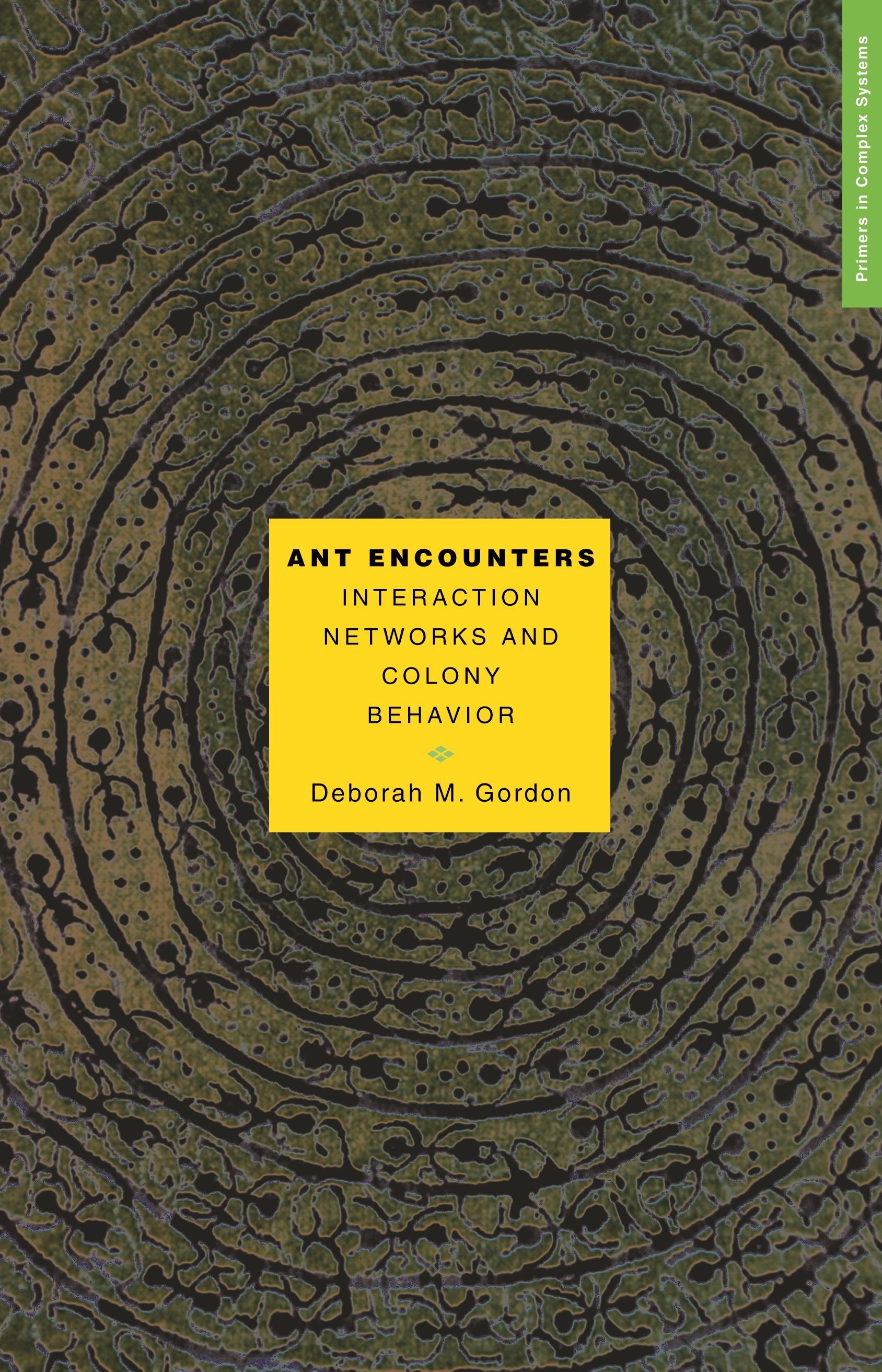
How do ant colonies get anything done, when no one is in charge? An ant colony operates without a central control or hierarchy, and no ant directs another. Instead, ants decide what to do based on the rate, rhythm, and pattern of individual encounters and interactions--resulting in a dynamic network that coordinates the functions of the colony. Ant Encounters provides a revealing and accessible look into ant behavior from this complex systems perspective.
Focusing on the moment-to-moment behavior of ant colonies, Deborah Gordon investigates the role of interaction networks in regulating colony behavior and relations among ant colonies. She shows how ant behavior within and between colonies arises from local interactions of individuals, and how interaction networks develop as a colony grows older and larger. The more rapidly ants react to their encounters, the more sensitively the entire colony responds to changing conditions. Gordon explores whether such reactive networks help a colony to survive and reproduce, how natural selection shapes colony networks, and how these structures compare to other analogous complex systems.
Ant Encounters sheds light on the organizational behavior, ecology, and evolution of these diverse and ubiquitous social insects.
Payez facilement par carte, Klarna, Apple Pay ou Google Pay. Pas satisfait ? Vous avez toujours une garantie de remboursement de 14 jours. En savoir plus dans nos conditions. Si vous avez des questions, envoyez-nous un e-mail à hello@memmo.org.
Memmo facilite tes études, où que tu sois dans le monde. On rassemble tes manuels de cours et des outils d'étude intelligents au même endroit : résumés, quiz, podcasts et flashcards. Et il y a Ted, ton compagnon d'étude qui répond à toutes tes questions. Plus de 50 000 étudiants étudient déjà ici – conçu pour t'aider à apprendre plus vite et à moins stresser.