
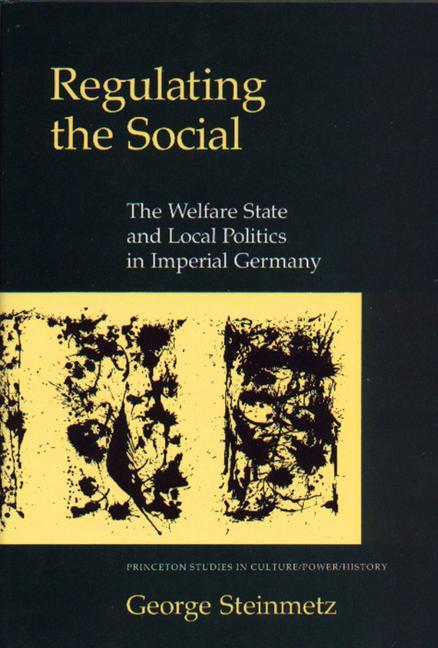
Why does the welfare state develop so unevenly across countries, regions, and localities? What accounts for the exclusions and disciplinary features of social programs? How are elite and popular conceptions of social reality related to welfare policies? George Steinmetz approaches these and other issues by exploring the complex origins and development of local and national social policies in nineteenth-century Germany. Generally regarded as the birthplace of the modern welfare state, Germany experimented with a wide variety of social programs before 1914, including the national social insurance legislation of the 1880s, the "Elberfeld" system of poor relief, protocorporatist policies, and modern forms of social work. Imperial Germany offers a particularly useful context in which to compare different programs at various levels of government.
Looking at changes in welfare policy over the course of the nineteenth century, differences between state and municipal interventions, and intercity variations in policy, Steinmetz develops an account that focuses on the specific constraints on local and national policymakers and the different ways of imagining the "social question." Whereas certain aspects of the pre-1914 welfare state reinforced social divisions and even foreshadowed aspects of the Nazi regime, other dimensions actually helped to relieve sickness, poverty, and unemployment. Steinmetz explores the conditions that led to both the positive and the objectionable features of social policy. The explanation draws on statist, Marxist, and social democratic perspectives and on theories of gender and culture.
Payez facilement par carte, Klarna, Apple Pay ou Google Pay. Pas satisfait ? Vous avez toujours une garantie de remboursement de 14 jours. En savoir plus dans nos conditions. Si vous avez des questions, envoyez-nous un e-mail à hello@memmo.org.
Memmo facilite tes études, où que tu sois dans le monde. On rassemble tes manuels de cours et des outils d'étude intelligents au même endroit : résumés, quiz, podcasts et flashcards. Et il y a Ted, ton compagnon d'étude qui répond à toutes tes questions. Plus de 50 000 étudiants étudient déjà ici – conçu pour t'aider à apprendre plus vite et à moins stresser.