
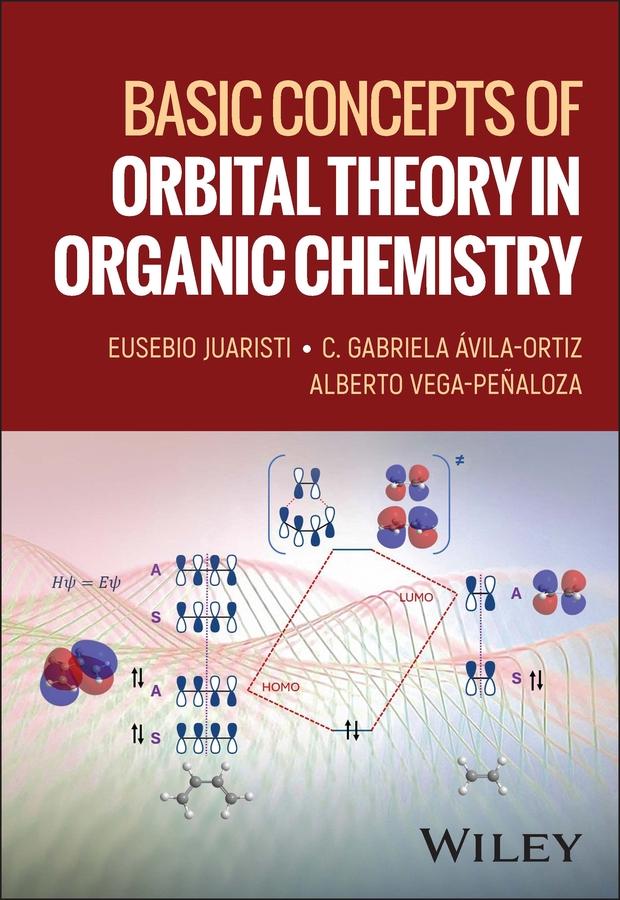
Increase your understanding of molecular properties and reactions with this accessible textbook
The study of organic chemistry hinges on an understanding and capacity to predict molecular properties and reactions. Molecular Orbital Theory is a model grounded in quantum mechanics deployed by chemists to describe electron organization within a chemical structure. It unlocks some of the most prevalent reactions in organic chemistry.
Basic Concepts of Orbital Theory in Organic Chemistry provides a concise, accessible overview of this theory and its applications. Beginning with fundamental concepts such as the shape and relative energy of atomic orbitals, it proceeds to describe the way these orbitals combine to form molecular orbitals, with important ramifications for molecular properties. The result is a work which helps students and readers move beyond localized bonding models and achieve a greater understanding of organic chemical interactions.
In Basic Concepts of Orbital Theory in Organic Chemistry readers will also find:
- Comprehensive explorations of stereoelectronic interactions and sigmatropic, cheletropic, and electrocyclic reactions,
- Detailed discussions of hybrid orbitals, bond formation in atomic orbitals, the Hückel Molecular Orbital Method, and the conservation of molecular orbital symmetry
- Sample exercises for organic chemistry students to help reinforce and retain essential concepts
Basic Concepts of Orbital Theory in Organic Chemistry is ideal for advanced undergraduate and graduate students in chemistry, particularly organic chemistry.
Payez facilement par carte, Klarna, Apple Pay ou Google Pay. Pas satisfait ? Vous avez toujours une garantie de remboursement de 14 jours. En savoir plus dans nos conditions. Si vous avez des questions, envoyez-nous un e-mail à hello@memmo.org.
Memmo facilite tes études, où que tu sois dans le monde. On rassemble tes manuels de cours et des outils d'étude intelligents au même endroit : résumés, quiz, podcasts et flashcards. Et il y a Ted, ton compagnon d'étude qui répond à toutes tes questions. Plus de 50 000 étudiants étudient déjà ici – conçu pour t'aider à apprendre plus vite et à moins stresser.