
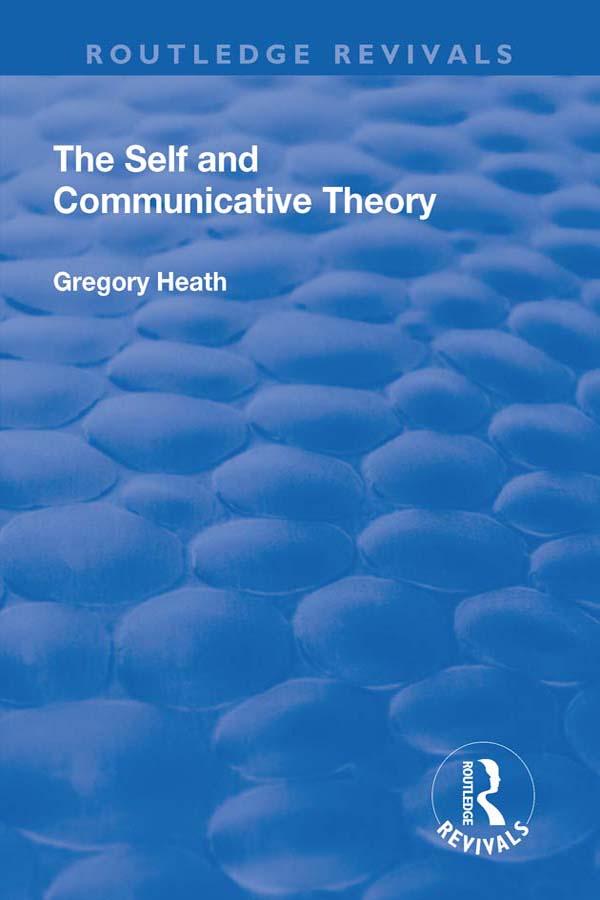
This title was first published in 2000: This text contributes to the development of communicative theory by advancing a theory of the self-sufficient to support intersubjectivity and meet the conditions required for communicative rationality and communicative reason. The conclusion supports theories advanced by Habermas, Apel and Wittgenstein, evaluated against the background of later works from Immanuel Kant. The origins of communicative theory in the writings of Kant and Charles Sanders Peirce are sketched, followed by an outline of the development of the theory by Apel and Habermas. In this discussion a central issues is identified as the failure of communicative theory to produce an adequate theory of the self as the subject of communicative transactions. It is argued that both Mead and Habermas fail to fully establish intersubjectivity as they retain elements of a Cartesian introspective subjectivity. An alternative approach, developed by Charles Taylor, is then discussed. Finally, it is argued that freedom and imagination, understood in the context of Kant and the late Wittgenstein are the key elements to a self capable of supporting the intersubjectivity required by communicative theory.
Payez facilement par carte, Klarna, Apple Pay ou Google Pay. Pas satisfait ? Vous avez toujours une garantie de remboursement de 14 jours. En savoir plus dans nos conditions. Si vous avez des questions, envoyez-nous un e-mail à hello@memmo.org.
Memmo facilite tes études, où que tu sois dans le monde. On rassemble tes manuels de cours et des outils d'étude intelligents au même endroit : résumés, quiz, podcasts et flashcards. Et il y a Ted, ton compagnon d'étude qui répond à toutes tes questions. Plus de 50 000 étudiants étudient déjà ici – conçu pour t'aider à apprendre plus vite et à moins stresser.