
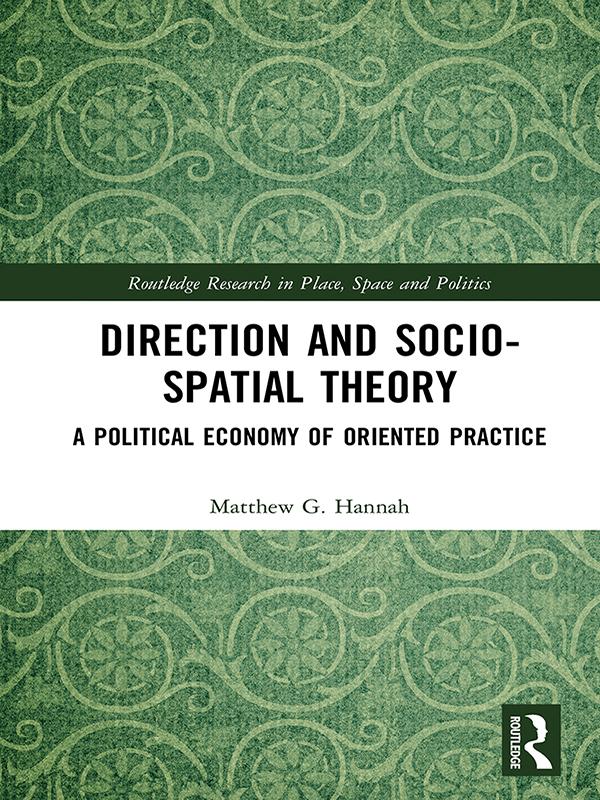
The embodied directedness of human practice has long been neglected in critical socio-spatial theory, in favor of analyses focused upon distance and proximity. This book illustrates the absence of a sense for direction in much theoretical discourse and lays important groundwork for redressing this lacuna in socio-spatial theory.
Many accounts of the social world are incomplete, or are increasingly out of step with recent developments of neoliberal capitalism. Not least through new technological mediations of production and consumption, the much-discussed waning of the importance of physical distance has been matched by the increasing centrality of turning from one thing to another as a basic way in which lives are structured and occupied. A sensibility for embodied processes of turning, and for phenomena of direction more generally, is urgently needed. Chapters develop wide-ranging and original engagements with the arguments of Sara Ahmed, Jonathan Beller, Edmund Husserl, Martin Heidegger, Virginia Held, Bernard Stiegler, Theodore Schatzki, Rahel Jaeggi, Hartmut Rosa and David Harvey.
This book reinterprets practice, embodiment, alienation, reification, social reproduction and ethical responsibility from a directional perspective. It will be a new valuable resource and reference for political and social geography students, as well as sociologists and anthropologists.
Payez facilement par carte, Klarna, Apple Pay ou Google Pay. Pas satisfait ? Vous avez toujours une garantie de remboursement de 14 jours. En savoir plus dans nos conditions. Si vous avez des questions, envoyez-nous un e-mail à hello@memmo.org.
Memmo facilite tes études, où que tu sois dans le monde. On rassemble tes manuels de cours et des outils d'étude intelligents au même endroit : résumés, quiz, podcasts et flashcards. Et il y a Ted, ton compagnon d'étude qui répond à toutes tes questions. Plus de 50 000 étudiants étudient déjà ici – conçu pour t'aider à apprendre plus vite et à moins stresser.