
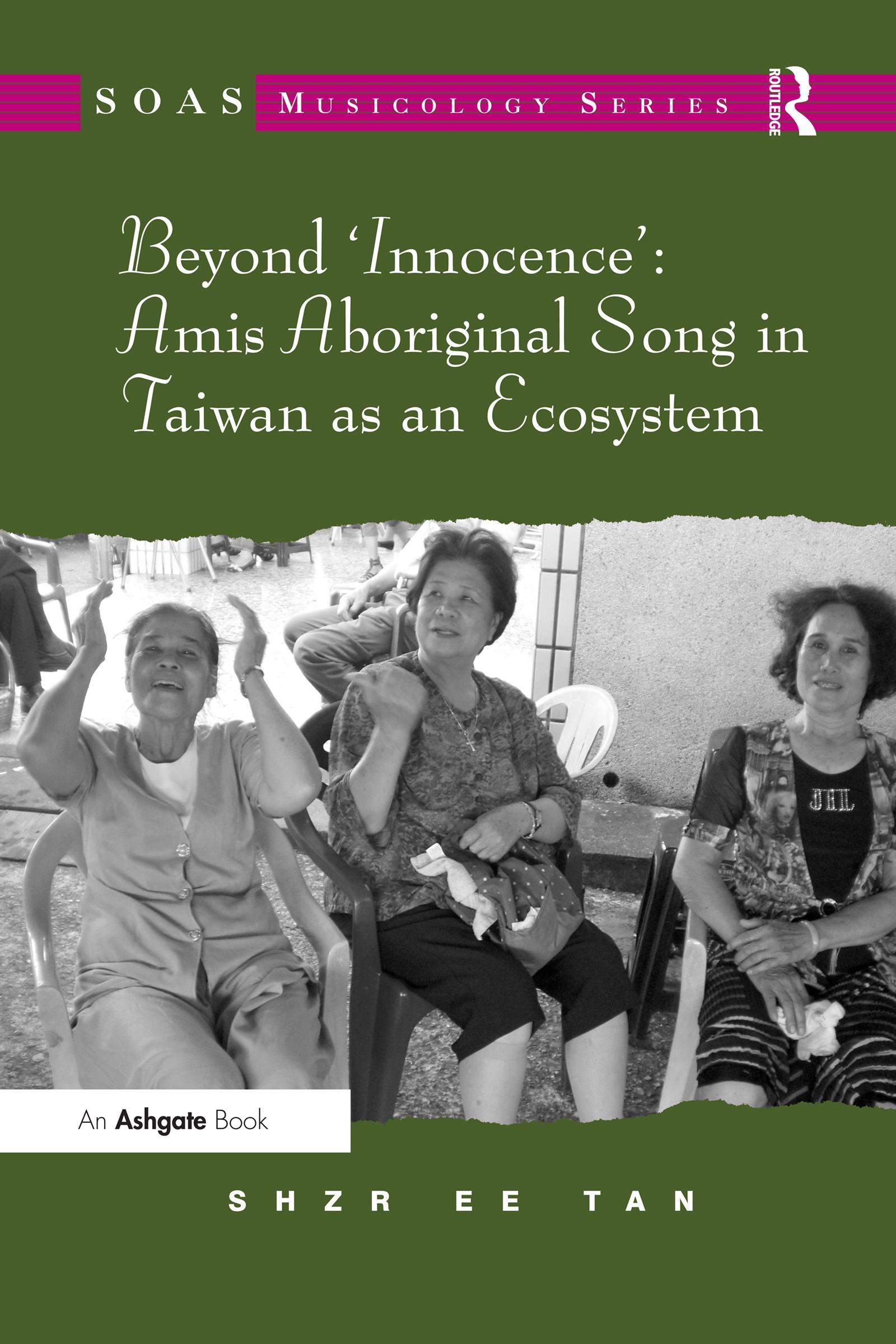
Taiwan aboriginal song has received extensive media coverage since the launch and settlement of a copyright lawsuit following pop group Enigma's allegedly unauthorized use of Amis voices in the 1996 Olympics hit, Return To Innocence. Taking as her starting point the ripple effects of this case, Shzr Ee Tan explores the relationship of this song culture to contemporary Amis society. She presents Amis song in its multiple manifestations as an ecosystem, symbiotic components of which interact and feed back upon one another in cross-cutting platforms of village life, festival celebration, cultural performance, popular song, art music and Christian hymnody. Tan's investigation hinges upon drawing a conceptual line between ladhiw, the Amis term for 'song' - a word vested with connotations of life-force, tradition, ritual and taboo - and the foreign term of yinyue ('music' - borrowed from Mandarin). This difference forms the basis of how Amis song is (re)constructed through processes of modernization, Christianization and politico-economic change. A single Amis melody, for example, can exist in several guises that are contextually exclusive but functionally mutually-supportive. Thus, a weeding song (ladhiw), which may have lost its traditional context of existence following advancements in farming technology, becomes sustained within a larger ecosystem, finding new life on the interacting platforms of Amis Catholic hymnody, karaoke and tourist shows. The latter genres (collectively, yinyue) may not rely on traditional livelihoods for survival, but thrive on a traditional melody's deeper associations to local memory and idealized Amis identities. While these new and old genres are stylistically separate, they feed into each other and back into themselves - through transforming contexts and cross-referenced memes - in organic and developing cycles of song activity. Drawing from fieldwork conducted from 2000-2010 as well as a background in ethnomusicology and journalism, Ta
Payez facilement par carte, Klarna, Apple Pay ou Google Pay. Pas satisfait ? Vous avez toujours une garantie de remboursement de 14 jours. En savoir plus dans nos conditions. Si vous avez des questions, envoyez-nous un e-mail à hello@memmo.org.
Memmo facilite tes études, où que tu sois dans le monde. On rassemble tes manuels de cours et des outils d'étude intelligents au même endroit : résumés, quiz, podcasts et flashcards. Et il y a Ted, ton compagnon d'étude qui répond à toutes tes questions. Plus de 50 000 étudiants étudient déjà ici – conçu pour t'aider à apprendre plus vite et à moins stresser.
Tu pourrais aussi aimer
Acheter le livre0