
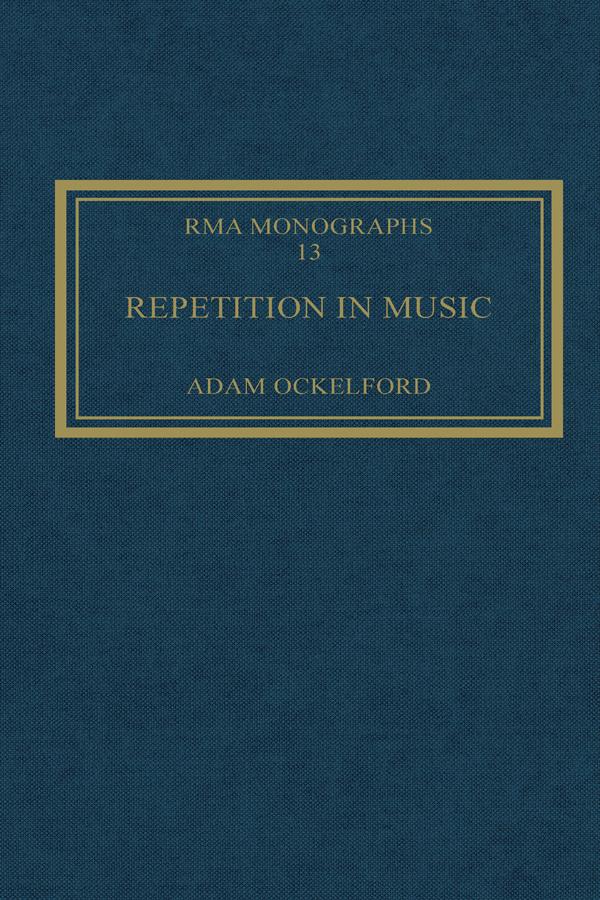
This monograph examines the place of repetition in perceived musical structure and in theories of music. Following a preface and introduction, there are four main chapters: 'Theory', 'Analysis', 'Metatheory and Meta-analysis', and 'Cognition and Metacognition'. Chapter 2 (Theory) sets out the principles underlying the creation and cognition of musical structure developed by the author in earlier studies, in the dual context of David Lewin's mathematically based theory of musical intervals and transformations and Gilles Fauconnier's concept of mental spaces (which was formulated in the context of cognitive science). Chapter 3 (Analysis) shows the theory in operation in relation to the first movement of Mozart's piano sonata K.333. It indicates how structural issues may be related to considerations of aesthetic response and musical 'worth' through comparison with J.C. Bach's Sonata op. 5 no. 3. Chapter 4 (Metatheory and Meta-analysis) uses the new theory to interrogate the propositions underpinning set theory and transformations, offering a psychomusicological critique and potential development of, for example, the work of Forte, Morris, Isaacson and Straus. This enables issues raised earlier in relation to the work of Lewin to be addressed. In conclusion, in Chapter 5 (Cognition and Metacognition), the matter of cognitive preferences and constraints is considered in relation to repetition in music, which permits a final investigation of different approaches to musical analysis to be undertaken. In summary, by synthesising the findings of diverse earlier work in the context of the new theory, it proves possible to move thinking forward on a number of fronts, and to indicate potential directions for future empirical and analytical developments.
Payez facilement par carte, Klarna, Apple Pay ou Google Pay. Pas satisfait ? Vous avez toujours une garantie de remboursement de 14 jours. En savoir plus dans nos conditions. Si vous avez des questions, envoyez-nous un e-mail à hello@memmo.org.
Memmo facilite tes études, où que tu sois dans le monde. On rassemble tes manuels de cours et des outils d'étude intelligents au même endroit : résumés, quiz, podcasts et flashcards. Et il y a Ted, ton compagnon d'étude qui répond à toutes tes questions. Plus de 50 000 étudiants étudient déjà ici – conçu pour t'aider à apprendre plus vite et à moins stresser.
Tu pourrais aussi aimer
Acheter le livre0