
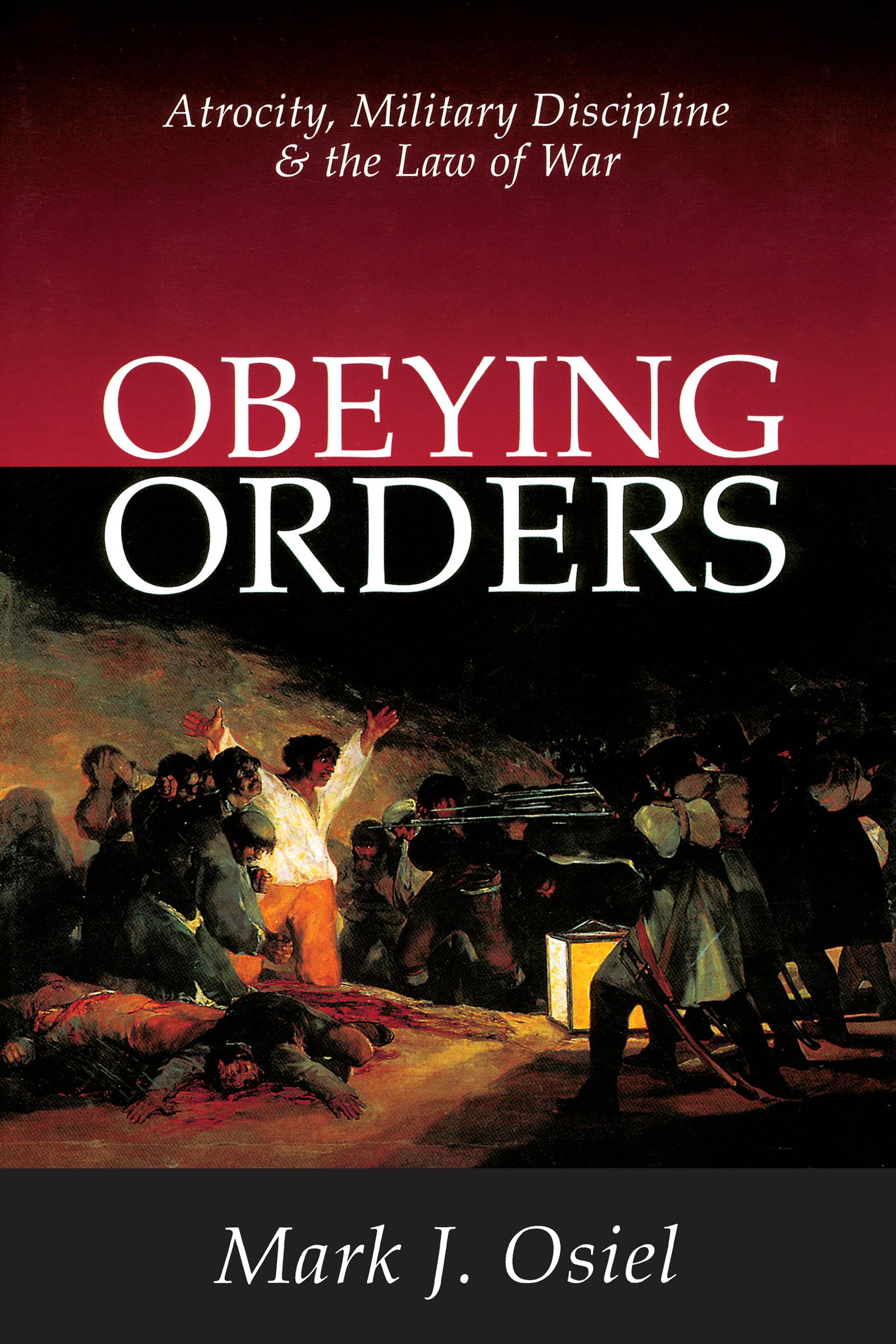
A soldier obeys illegal orders, thinking them lawful. When should we excuse his misconduct as based in reasonable error? How can courts convincingly convict the soldier's superior officer when, after Nuremberg, criminal orders are expressed through winks and nods, hints and insinuations? Can our notions of the soldier's "due obedience," designed for the Roman legionnaire, be brought into closer harmony with current understandings of military conflict in the contemporary world? Mark J. Osiel answers these questions in light of new learning about atrocity and combat cohesion, as well as changes in warfare and the nature of military conflict. Sources of atrocity are far more varied than current law assumes, and such variations display consistent patterns. The law now generally requires that soldiers resolve all doubts about the legality of a superior's order in favor of obedience. It excuses compliance with an illegal order unless the illegality - as with flagrant atrocities - would be immediately obvious to anyone. But these criteria are often in conflict and at odds with the law's underlying principles and policies. Combat and peace operations now depend more on tactical imagination, self-discipline, and loyalty to immediate comrades than on immediate, unreflective adherence to the letter of superiors' orders, backed by threat of formal punishment. The objective of military law is to encourage deliberative judgment. This can be done, Osiel suggests, in ways that enhance the accountability of our military forces, in both peace operations and more traditional conflicts, while maintaining their effectiveness. Osiel seeks to "civilianize" military law while building on soldiers' own internal ideals of professional virtuousness. He returns to the ancient ideal of martial honor, reinterpreting it in light of new conditions, arguing that it should be implemented through realistic training in which legal counsel plays an enlarged role rather than by threat of legal prosecution. Obeying Orders thus offers a compelling answer to the question that has most haunted the moral imagination of the late twentieth century: the roots - and restraint - of mass atrocity in war.
Payez facilement par carte, Klarna, Apple Pay ou Google Pay. Pas satisfait ? Vous avez toujours une garantie de remboursement de 14 jours. En savoir plus dans nos conditions. Si vous avez des questions, envoyez-nous un e-mail à hello@memmo.org.
Memmo facilite tes études, où que tu sois dans le monde. On rassemble tes manuels de cours et des outils d'étude intelligents au même endroit : résumés, quiz, podcasts et flashcards. Et il y a Ted, ton compagnon d'étude qui répond à toutes tes questions. Plus de 50 000 étudiants étudient déjà ici – conçu pour t'aider à apprendre plus vite et à moins stresser.
Tu pourrais aussi aimer
Acheter le livre0