
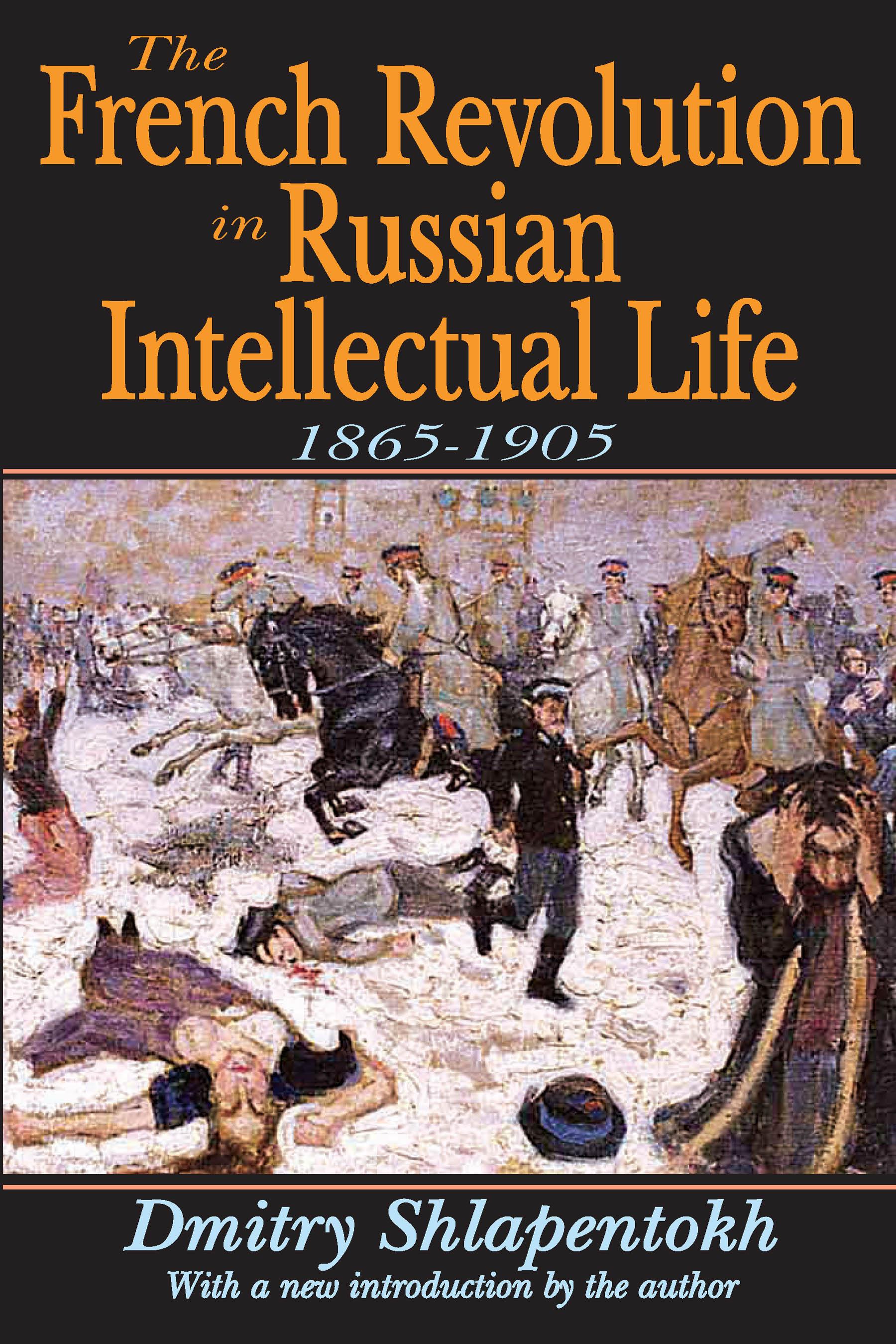
Sandwiched between the East and West, Russian intellectuals have for centuries been divided geographically, politically, and culturally into two distinct groups: the Slavophiles, who rejected Western-style democracy, preferring a more holistic and abstract vision, and the more rational and scientific-minded Westernizers. These two ideologies cut across the political spectrum of late nineteenth-century Russia and competed for dominance in the country's intellectual life. The tension created between these two opposing groups caused the feeling that violent upheaval was Russia's future. In turn, many began to think that Russia was possibly following the path of France and that a French-style revolution might be possible on Russian soil. In The French Revolution in Russian Intellectual Life, Dmitry Shlapentokh describes the role that the French democratic revolution played in Russia's intellectual development by the end of the nineteenth century.
The revolutionary upheaval in Russia at the beginning of twentieth century and the continuous expansion of the West convinced most Russian intellectuals that the French Revolution in its democratic reading was indeed the pathway of history. Yet the rise of totalitarian regimes and their expansion proved the validity of the sober vision of nineteenth-century Russian intellectuals. Some conservative Russian intellectuals believed that not only would Russia preserve its authoritarian regime but it would spread this regime all over the world. In this context, Shlapentokh argues the French Revolution with its democratic tradition was only a phenomenon of Western civilization and hence transitory.
The flirtation with Western ideology, with its democratic polity and market economy that followed in the wake of the collapse of the communist regime, culminated in an increasing push for corporate authoritarianism and nationalism. This work helps explain why Russia turned away from democratic to autocratic stylesi?1
Payez facilement par carte, Klarna, Apple Pay ou Google Pay. Pas satisfait ? Vous avez toujours une garantie de remboursement de 14 jours. En savoir plus dans nos conditions. Si vous avez des questions, envoyez-nous un e-mail à hello@memmo.org.
Memmo facilite tes études, où que tu sois dans le monde. On rassemble tes manuels de cours et des outils d'étude intelligents au même endroit : résumés, quiz, podcasts et flashcards. Et il y a Ted, ton compagnon d'étude qui répond à toutes tes questions. Plus de 50 000 étudiants étudient déjà ici – conçu pour t'aider à apprendre plus vite et à moins stresser.