
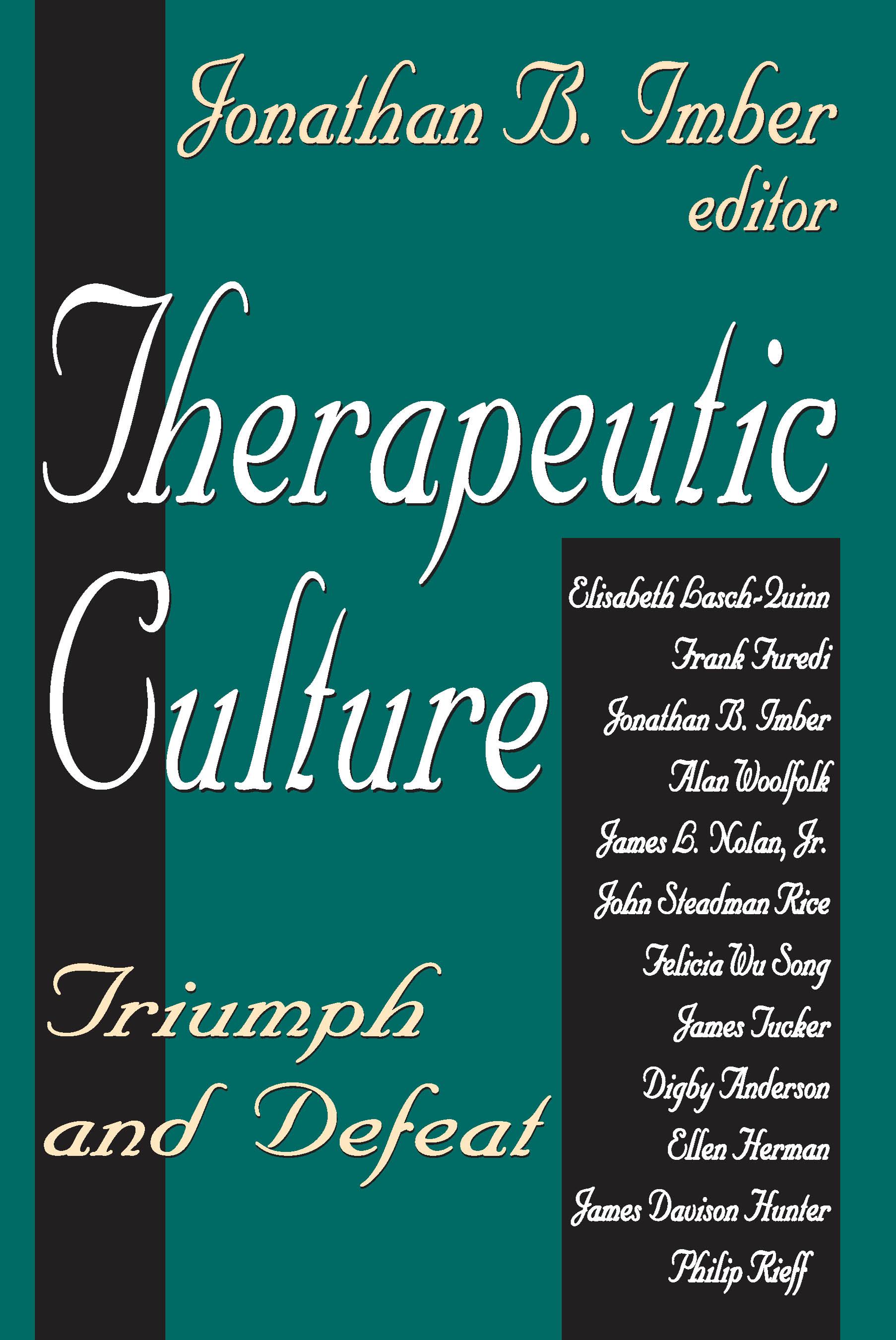
For nearly half a century, social scientists have made claims that there is a "therapeutic ethos" with extensive influence upon numerous aspects of American society. In Therapeutic Culture, twelve authors address the implications of this ethos and its effects on a wide range of social institutions, extending from the family to schools, and operating in religious behavior and within the legal system. Has there been, as the sociological theorist Philip Rieff argued in 1966, a "triumph of the therapeutic?" If so, in what kinds of institutions has it been most pervasive? At the same time, what aspects of modern culture has it replaced or defeated? Therapeutic Culture addresses these questions, and raises others. Part 1 of this volume examines the emergence of the idea of "authenticity" as it defines the manipulation of emotions and behavior both in the United States and Great Britain. Contributors include Elisabeth Lasch-Quinn, Frank Furedi, Jonathan B. Imber, and Alan Woolfolk. Part 2 illustrates specific cases of the effects of therapeutic culture within institutions, including courts, schools, religious communities, and the "virtual community" of the Internet. Contributors include James L. Nolan, Jr., John Steadman Rice, Felicia Wu Song, and James Tucker. Part 3 extends the analyses of specific social institutions to the broader consequences that have resulted as a therapeutic ethos has taken root in contemporary life. Contributors include Digby Anderson, Ellen Herman, and James Davison Hunter. Part 4 is devoted to a previously unpublished essay by Philip Rieff whose significant influence can be seen in many of the contributions. Rieff revisits the highly controversial confirmation hearings of Supreme Court Associate Justice Clarence Thomas in 1991 and offers ample evidence of the therapeutic uses of politics as well as the political manipulations available within a therapeutic culture to provide a fitting conclusion. This volume establishes a benchmark for furthe
Payez facilement par carte, Klarna, Apple Pay ou Google Pay. Pas satisfait ? Vous avez toujours une garantie de remboursement de 14 jours. En savoir plus dans nos conditions. Si vous avez des questions, envoyez-nous un e-mail à hello@memmo.org.
Memmo facilite tes études, où que tu sois dans le monde. On rassemble tes manuels de cours et des outils d'étude intelligents au même endroit : résumés, quiz, podcasts et flashcards. Et il y a Ted, ton compagnon d'étude qui répond à toutes tes questions. Plus de 50 000 étudiants étudient déjà ici – conçu pour t'aider à apprendre plus vite et à moins stresser.
Tu pourrais aussi aimer
Acheter le livre0