
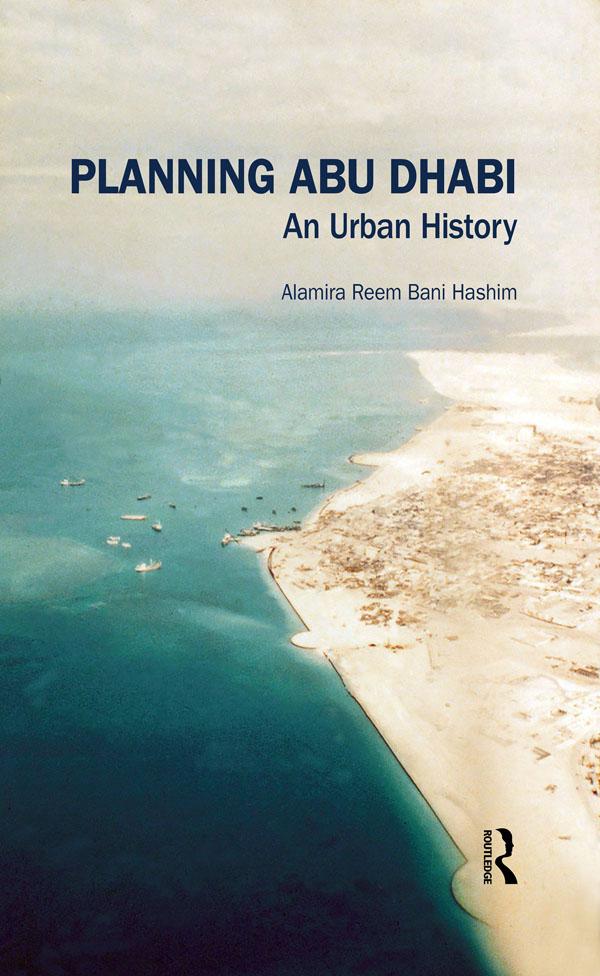
Abu Dhabi’s urban development path contrasts sharply with its exuberant neighbour, Dubai. As Alamira Reem puts it, Abu Dhabi, capital of the United Arab Emirates since 1971, ‘has been quietly devising its own plans … to manifest its role and stature as a capital city’.
Alamira Reem, a native Abu Dhabian and urban planner and researcher who has studied the emirate’s development for more than a decade, is uniquely placed to write its urban history. Following the introduction and description of Abu Dhabi’s early modern history, she focuses on three distinct periods dating from the discovery of oil in 1960, and coinciding with periods in power of the three rulers since then: Sheikh Shakhbut bin Sultan Al Nahyan (1960–1966), Sheikh Zayed bin Sultan Al Nahyan (1966–2004), and Sheikh Khalifa bin Zayed Al Nahyan (2004–). Based on archival research, key interviews and spatial mapping, she analyses the different approaches of each ruler to development; investigates the role of planning consultants, architects, developers, construction companies and government agencies; examines the emergence of comprehensive development plans and the policies underlying them; and assesses the effects of these many and varied influences on Abu Dhabi’s development. She concludes that, while much still needs to be done, Abu Dhabi’s progress towards becoming a global, sustainable city provides lessons for cities elsewhere.
Payez facilement par carte, Klarna, Apple Pay ou Google Pay. Pas satisfait ? Vous avez toujours une garantie de remboursement de 14 jours. En savoir plus dans nos conditions. Si vous avez des questions, envoyez-nous un e-mail à hello@memmo.org.
Memmo facilite tes études, où que tu sois dans le monde. On rassemble tes manuels de cours et des outils d'étude intelligents au même endroit : résumés, quiz, podcasts et flashcards. Et il y a Ted, ton compagnon d'étude qui répond à toutes tes questions. Plus de 50 000 étudiants étudient déjà ici – conçu pour t'aider à apprendre plus vite et à moins stresser.