
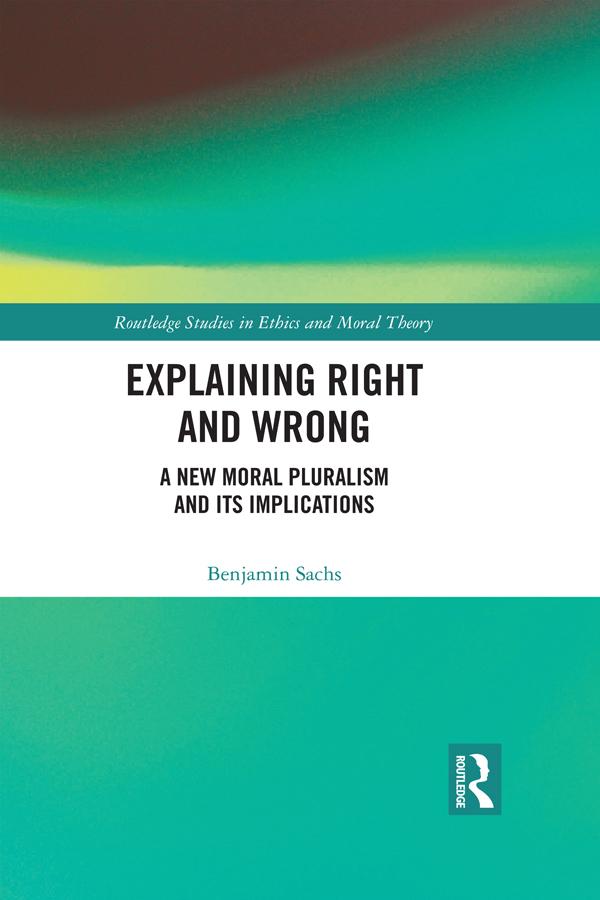
Explaining Right and Wrong aims to shake the foundations of contemporary ethics by showing that moral philosophers have been deploying a mistaken methodology in their efforts to figure out the truth about what we morally ought to do. Benjamin Sachs argues that moral theorizing makes sense only if it is conceived of as an explanatory project and carried out accordingly. The book goes on to show that the most prominent forms of moral monism—consequentialism, Kantianism, and contractarianism/contractualism—as well as Rossian pluralism, each face devastating explanatory objections. It offers in place of these flawed options a brand-new family of normative ethical theories, non-Rossian pluralism. It then argues that the best kind of non-Rossian pluralism will be spare; in particular, it will deny that an action can be wrong in virtue of constituting a failure to distribute welfare in a particular way or that an action can be wrong in virtue of constituting a failure to rescue. Furthermore, it also aims to show that a great deal of contemporary writing on the distribution of health care resources in cases of scarcity is targeted at questions that either have no answers at all or none that ordinary moral theorizing can uncover.
Payez facilement par carte, Klarna, Apple Pay ou Google Pay. Pas satisfait ? Vous avez toujours une garantie de remboursement de 14 jours. En savoir plus dans nos conditions. Si vous avez des questions, envoyez-nous un e-mail à hello@memmo.org.
Memmo facilite tes études, où que tu sois dans le monde. On rassemble tes manuels de cours et des outils d'étude intelligents au même endroit : résumés, quiz, podcasts et flashcards. Et il y a Ted, ton compagnon d'étude qui répond à toutes tes questions. Plus de 50 000 étudiants étudient déjà ici – conçu pour t'aider à apprendre plus vite et à moins stresser.