
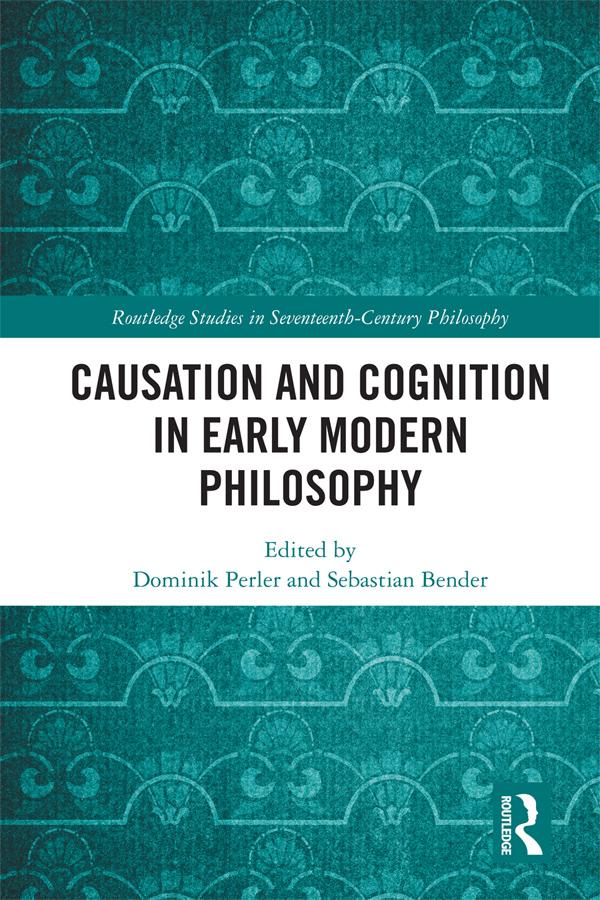
This book re-examines the roles of causation and cognition in early modern philosophy. The standard historical narrative suggests that early modern thinkers abandoned Aristotelian models of formal causation in favor of doctrines that appealed to relations of efficient causation between material objects and cognizers. This narrative has been criticized in recent scholarship from at least two directions. Scholars have emphasized that we should not think of the Aristotelian tradition in such monolithic terms, and that many early modern thinkers did not unequivocally reduce all causation to efficient causation.
In line with this general approach, this book features original essays written by leading experts in early modern philosophy. It is organized around five guiding questions:
- What are the entities involved in causal processes leading to cognition?
- What type(s) or kind(s) of causality are at stake? Are early modern thinkers confined to efficient causation or do other types of causation play a role?
- What is God's role in causal processes leading to cognition?
- How do cognitive causal processes relate to other, non-cognitive causal processes?
- Is the causal process in the case of human cognition in any way special? How does it relate to processes involved in the case of non-human cognition?
The essays explore how fifteen early modern thinkers answered these questions: Francisco Suárez, René Descartes, Louis de la Forge, Géraud de Cordemoy, Nicolas Malebranche, Thomas Hobbes, Baruch de Spinoza, Gottfried Wilhelm Leibniz, Ralph Cudworth, Margaret Cavendish, John Locke, John Sergeant, George Berkeley, David Hume, and Thomas Reid. The volume is unique in that it explores both well-known and understudied historical figures, and in that it emphasizes the intimate relationship between causation and cognition to open up new perspectives on early modern philosophy of mind and metaphysics.
Payez facilement par carte, Klarna, Apple Pay ou Google Pay. Pas satisfait ? Vous avez toujours une garantie de remboursement de 14 jours. En savoir plus dans nos conditions. Si vous avez des questions, envoyez-nous un e-mail à hello@memmo.org.
Memmo facilite tes études, où que tu sois dans le monde. On rassemble tes manuels de cours et des outils d'étude intelligents au même endroit : résumés, quiz, podcasts et flashcards. Et il y a Ted, ton compagnon d'étude qui répond à toutes tes questions. Plus de 50 000 étudiants étudient déjà ici – conçu pour t'aider à apprendre plus vite et à moins stresser.