
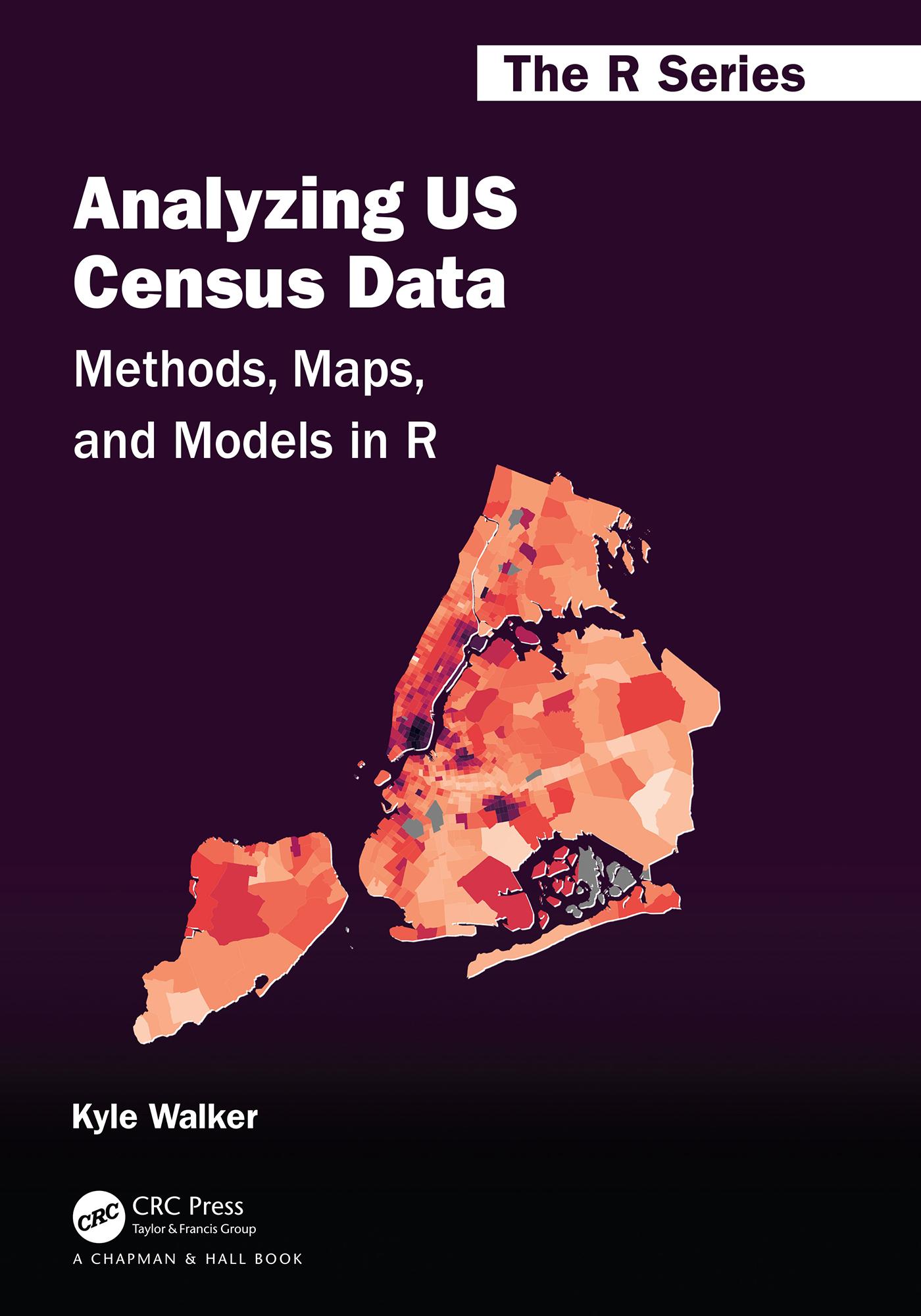
Census data is widely used by practitioners to understand demographic change, allocate resources, address inequalities, and make sound business decisions. Until recently, projects using US Census data have required proficiency with multiple web interfaces and software platforms to prepare, map, and present data products. This book introduces readers to tools in the R programming language for accessing and analyzing Census data and shows how to carry out demographic analyses in a single computing environment.
Chapters in this book cover the following key topics:
• Rapidly acquiring data from the decennial US Census and American Community Survey using R, then analyzing these datasets using tidyverse tools;
• Visualizing US Census data with a wide range of methods including charts in ggplot2 as well as both static and interactive maps;
• Using R as a geographic information system (GIS) to manage, analyze, and model spatial demographic data from the US Census;
• Working with and modeling individual-level microdata from the American Community Survey’s PUMS datasets;
• Applying these tools and workflows to the analysis of historical Census data, other US government datasets, and international Census data from countries like Canada, Brazil, Kenya, and Mexico.
Payez facilement par carte, Klarna, Apple Pay ou Google Pay. Pas satisfait ? Vous avez toujours une garantie de remboursement de 14 jours. En savoir plus dans nos conditions. Si vous avez des questions, envoyez-nous un e-mail à hello@memmo.org.
Memmo facilite tes études, où que tu sois dans le monde. On rassemble tes manuels de cours et des outils d'étude intelligents au même endroit : résumés, quiz, podcasts et flashcards. Et il y a Ted, ton compagnon d'étude qui répond à toutes tes questions. Plus de 50 000 étudiants étudient déjà ici – conçu pour t'aider à apprendre plus vite et à moins stresser.