
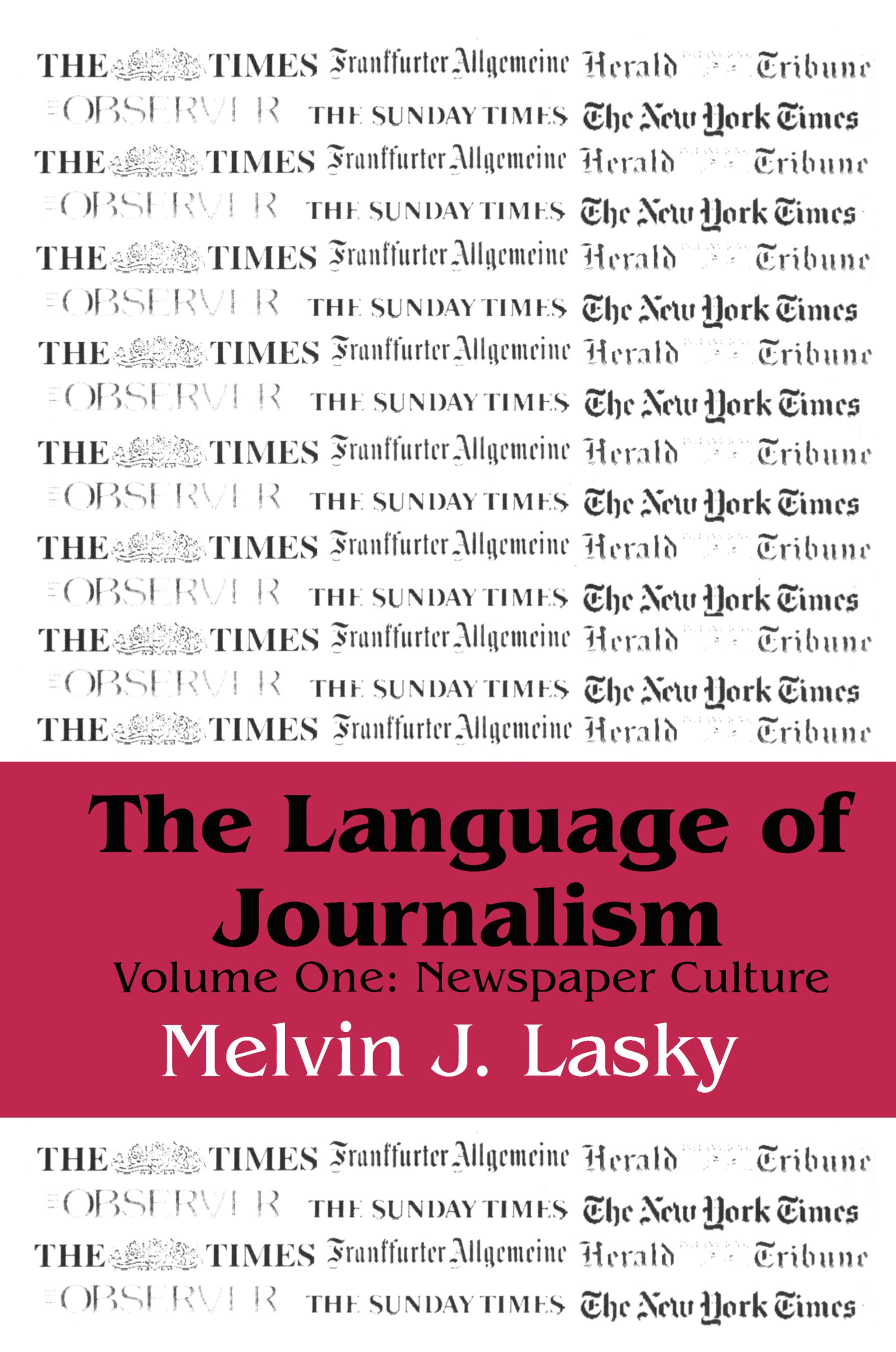
The newspaper is to the twentieth century what the novel was for the nineteenth century: the expression of popular sentiment. In the first of a three-volume study of journalism and what it has meant as a source of knowledge and as a mechanism for orchestrating mass ideology, Melvin J. Lasky provides a major overview. His research runs the gamut of material found in newspapers, from the trivial to the profound, from pseudo-science to habits of solid investigation.
The volume is divided into four parts. The first attacks deficiencies in grammar and syntax with examples from newspapers and magazines drawn from the German as well as English-language press. The second examines the key issues of journalism: accuracy and authenticity. Lasky provides an especially acute account of differences between active literacy and passive viewing, or the relationship of word and picture in defining authenticity.
The third part emphasizes the problem of bias in everything from racial reporting to cultural correctness. This is the first systematic attempt to study racial nomenclature, identity-labeling, and literary discrimination. Lasky follows closely the model set by George Orwell a half century earlier. The final section of the work covers the competition between popular media and the redefinition of pornography and its language. The volume closes with an examination of how the popular culture both influenced and was influential upon literary titans like Hemingway, Lawrence, and Tynan.
Payez facilement par carte, Klarna, Apple Pay ou Google Pay. Pas satisfait ? Vous avez toujours une garantie de remboursement de 14 jours. En savoir plus dans nos conditions. Si vous avez des questions, envoyez-nous un e-mail à hello@memmo.org.
Memmo facilite tes études, où que tu sois dans le monde. On rassemble tes manuels de cours et des outils d'étude intelligents au même endroit : résumés, quiz, podcasts et flashcards. Et il y a Ted, ton compagnon d'étude qui répond à toutes tes questions. Plus de 50 000 étudiants étudient déjà ici – conçu pour t'aider à apprendre plus vite et à moins stresser.