
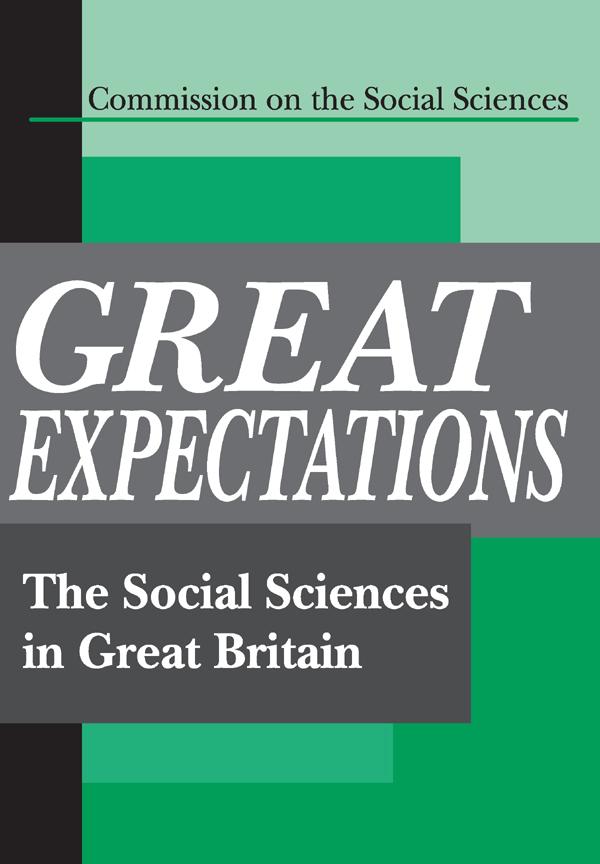
The social sciences in the United Kingdom are extensive, diverse and influential. At any one time, more than four million students study the social sciences in schools; and about a half million students study social science in universities. Total university income from the social sciences is at the four billion dollar level. Beyond that, many social scientists hold key positions in government, business, the media, civil service, and the voluntary sector. Great Expectations reviews the status of the social sciences in Great Britain at the beginning of the twenty-first century. While making clear that work opportunities for social scientists are substantial and that levels of intellectual performance equal that of graduates in physics, it provides a hard hitting, empirically grounded examination of a near crisis situation. The report goes far beyond what one conventionally expects in commissioned reports, arguing that the academic treadmill, driven by excessive accountability burdens, reduces the originality and quality of much academic research. The report emphasizes the ideological and parochial nature of much British social research. As a result, there is little applicability internationally, even less interdisciplinary work, and at times, an outright bias against the market economy as such. The Commission Report, is even handed, tough minded, and frank in discussing how it is that social science and new social and technical forces do not always mesh. The optimism exuded is measured, but genuine. Great Expectations offers policy recommendations and scientific goals that can be serviceable not only in the United Kingdom, but in all advanced societies in which social research is a central component of economic stability and development. It is a superb reference volume enriched by original analysis and pungent, clear-headed writing. Members of the commission include: Professor David Rhind, Vice Chancellor of the City University served as Chairman of the Commission. Members included Huw Beynon (Cardiff), Patricia Broadbent (Bristol), Vicki Bruce (Edinburgh), Barry Buzzan (LSE), Sue Duncan (Government Researcher), Stuart Etherington (National Council for Voluntary Organizations), Janet Lewis (Oxford), Denise Lievesley (UNESCO), Richard Portes (LBS), Marc Renaud (Research Council of Canada), Michael Tonry (Cambridge), and David Walker (The Guardian).
Payez facilement par carte, Klarna, Apple Pay ou Google Pay. Pas satisfait ? Vous avez toujours une garantie de remboursement de 14 jours. En savoir plus dans nos conditions. Si vous avez des questions, envoyez-nous un e-mail à hello@memmo.org.
Memmo facilite tes études, où que tu sois dans le monde. On rassemble tes manuels de cours et des outils d'étude intelligents au même endroit : résumés, quiz, podcasts et flashcards. Et il y a Ted, ton compagnon d'étude qui répond à toutes tes questions. Plus de 50 000 étudiants étudient déjà ici – conçu pour t'aider à apprendre plus vite et à moins stresser.
Tu pourrais aussi aimer
Acheter le livre0