
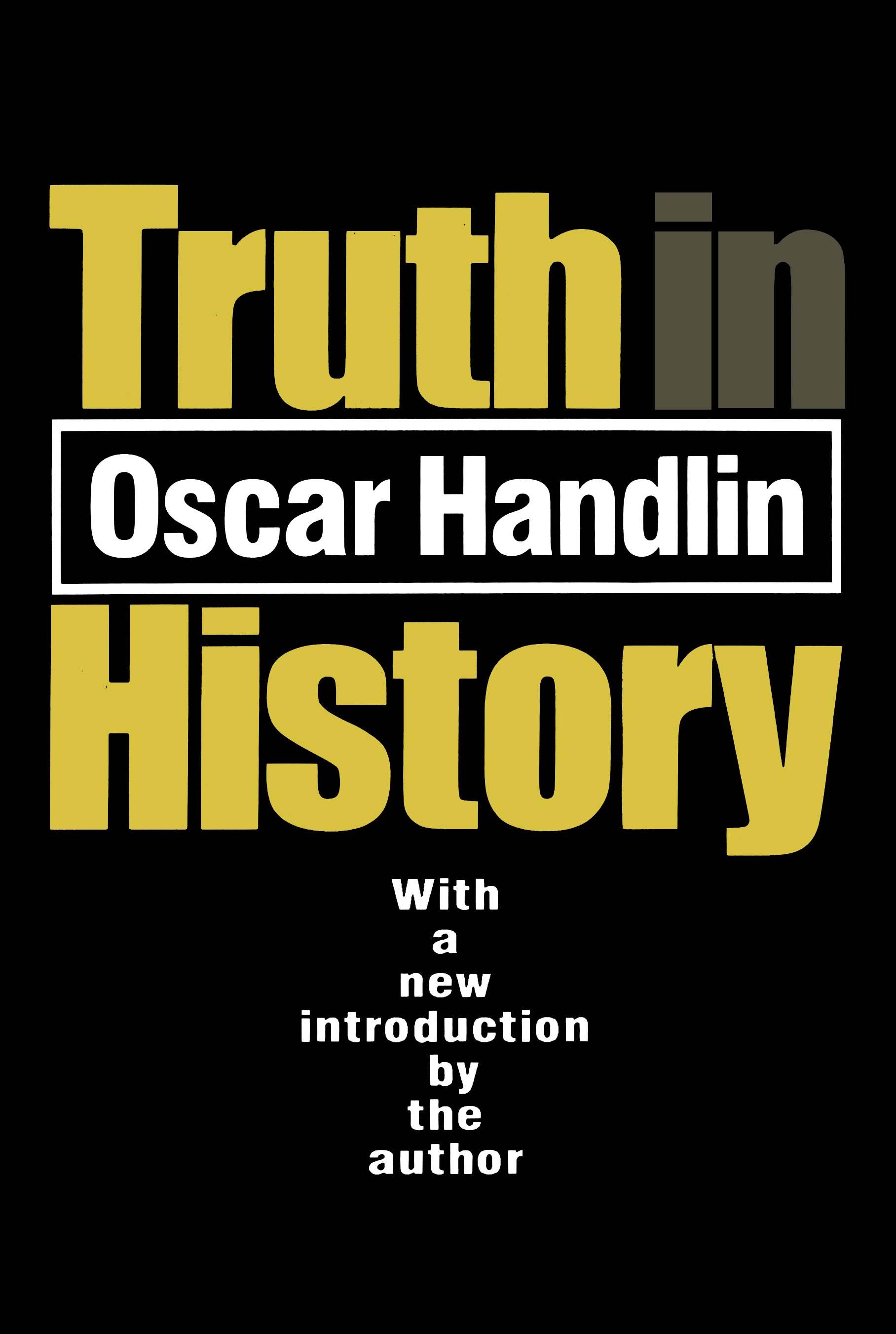
Like scholars in other fields, historians have long occupied themselves in self-justification. In a society which calibrates all measures by a single standard, the proof of scientific worth became relevance, which in turn was interpreted as a search not for truth but for political correctness. In a blistering professional critique of this tendency in academic scholarship, perhaps the first of its kind, Oscar Handlin offers an analysis that, if anything, has grown more pertinent over the past decade.
In seventeen chapters, written with the brilliant assurance of a master craftsman, Handlin shows why the turn to partisanship and meaning has undermined the calling of historical research. As his new introduction makes clear, partisanship has taken the best and brightest from the field into different callings. Both widely heralded upon its initial appearance as well as attacked with vigor, Truth in History emanates from a half-century's experience of reading, writing, teaching, researching, and publishing in history and related disciplines. The passage of time has only confirmed the concerns of Handlin and the accuracy of his predictions for the field. This book will be valuable for sociologists, economists, political scientists, and historians. It is a must read for those who contemplate a life of scholarship in liberal arts.
Payez facilement par carte, Klarna, Apple Pay ou Google Pay. Pas satisfait ? Vous avez toujours une garantie de remboursement de 14 jours. En savoir plus dans nos conditions. Si vous avez des questions, envoyez-nous un e-mail à hello@memmo.org.
Memmo facilite tes études, où que tu sois dans le monde. On rassemble tes manuels de cours et des outils d'étude intelligents au même endroit : résumés, quiz, podcasts et flashcards. Et il y a Ted, ton compagnon d'étude qui répond à toutes tes questions. Plus de 50 000 étudiants étudient déjà ici – conçu pour t'aider à apprendre plus vite et à moins stresser.