
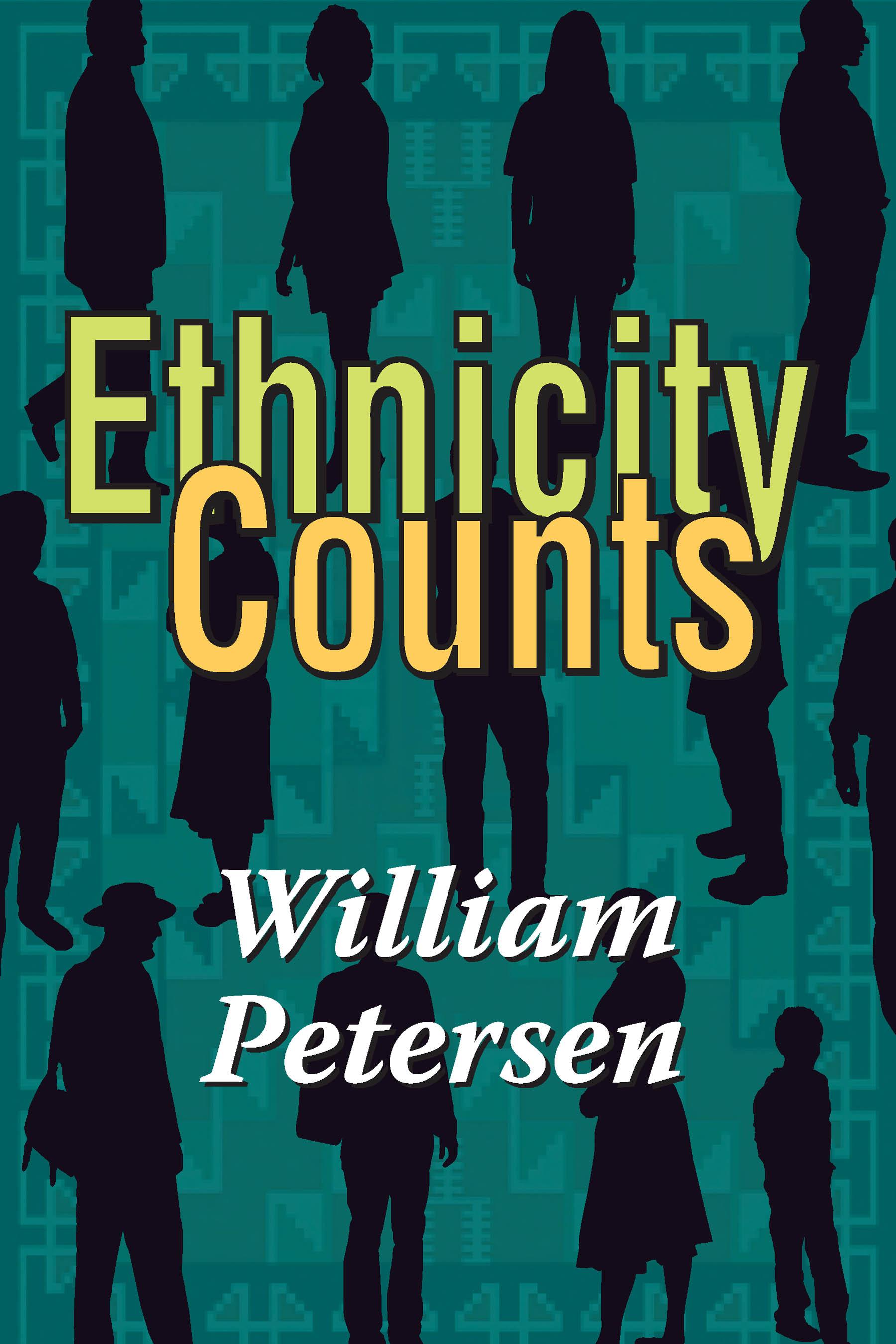
Official statistics about ethnicity in advanced societies are no better than those in less developed countries. An open industrial society is inherently fluid, and it is as hard to interpret social class and ethnic groups there as in a nearly static community. In consequence, the collection and interpretation of ethnic statistics is frequently a battleground where the groups being counted contest each element of every enumeration.
William Petersen describes how ethnic identity is determined and how ethnic or racial units are counted by official statistical agencies in the United States and elsewhere. The chapters in this book cover such topics as: "Identification of Americans of European Descent," "Differentiation among Blacks," "Ethnic Relations in the Netherlands," "Two Case Studies: Japan and Switzerland," and "Who is a Jew?"
Petersen argues that the general public is overly impressed by assertions about ethnicity, particularly if they are supported by numbers and graphs. The flood of American writings about race and ethnicity gives no sign of abatement. Ethnicity Counts offers an indispensible background to meaningful interpretation of statistics on ethnicity, and will be important to sociologists, historians, policymakers, and government officials.
Payez facilement par carte, Klarna, Apple Pay ou Google Pay. Pas satisfait ? Vous avez toujours une garantie de remboursement de 14 jours. En savoir plus dans nos conditions. Si vous avez des questions, envoyez-nous un e-mail à hello@memmo.org.
Memmo facilite tes études, où que tu sois dans le monde. On rassemble tes manuels de cours et des outils d'étude intelligents au même endroit : résumés, quiz, podcasts et flashcards. Et il y a Ted, ton compagnon d'étude qui répond à toutes tes questions. Plus de 50 000 étudiants étudient déjà ici – conçu pour t'aider à apprendre plus vite et à moins stresser.