
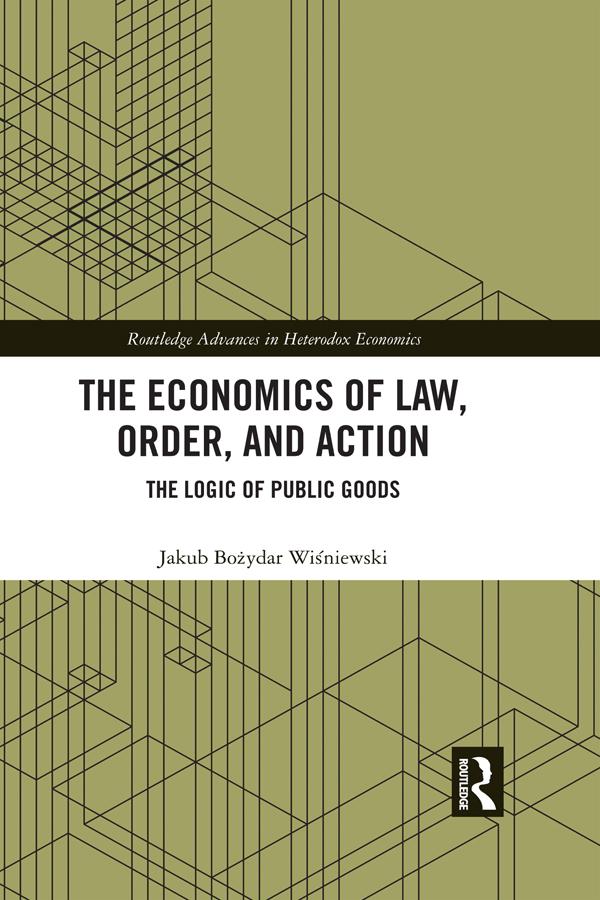
According to the standard position of the economic mainstream, the efficient production of so-called public goods, including law and defense, requires the use of territorial monopolies of coercive force. Two arguments are put forward for this position: a "positive" one, based on the claim that only such institutions can successfully supply society with crucial public goods, and a "negative" one, based on the claim that such institutions by themselves constitute inevitable "public bads".
This book challenges this assumption by utilizing the insights of the Austrian School of Economics, New Institutionalism, constitutional political economy, and other heterodox economic approaches, combined with economically informed ethical analysis. It puts forward a positive case for voluntary social organization that offers new insights into the intersection of economic logic, social philosophy, institutional analysis, and the theory of entrepreneurship. In other words, in an attempt to draw on the interdisciplinary spirit of classical political economy, this book aims at providing a comprehensive economic and ethical case for extending the applicability of voluntary, entrepreneurial cooperation to the realm of creating and sustaining legal and protective services together with attendant institutional frameworks.
Payez facilement par carte, Klarna, Apple Pay ou Google Pay. Pas satisfait ? Vous avez toujours une garantie de remboursement de 14 jours. En savoir plus dans nos conditions. Si vous avez des questions, envoyez-nous un e-mail à hello@memmo.org.
Memmo facilite tes études, où que tu sois dans le monde. On rassemble tes manuels de cours et des outils d'étude intelligents au même endroit : résumés, quiz, podcasts et flashcards. Et il y a Ted, ton compagnon d'étude qui répond à toutes tes questions. Plus de 50 000 étudiants étudient déjà ici – conçu pour t'aider à apprendre plus vite et à moins stresser.