
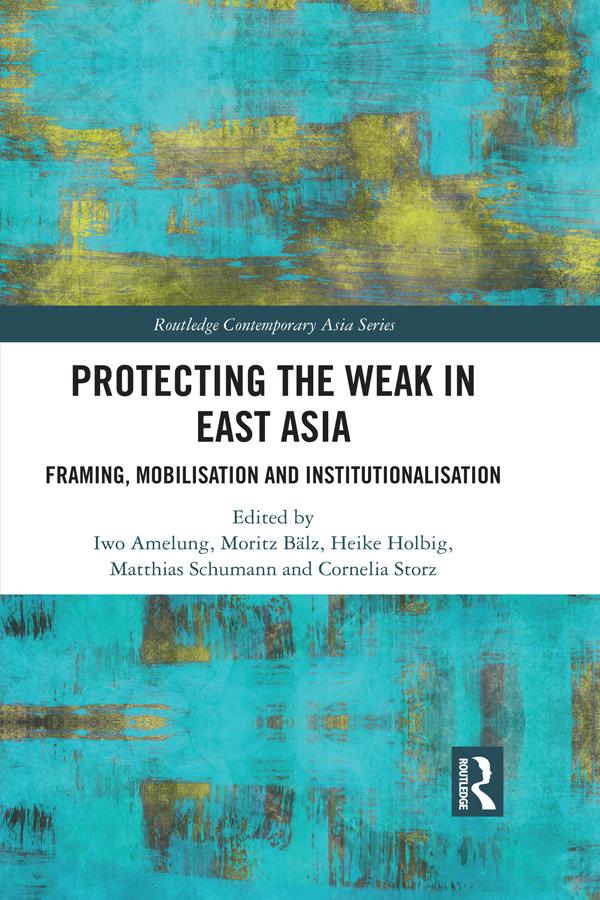
This book investigates public claims for the protection of weak groups and interests in Japan and China from the nineteenth century to the present day. Taking an interdisciplinary approach, it engages with ongoing global debates relevant to both Western and non-Western societies whilst also providing an historically informed analysis of contemporary issues.
Using case studies on disaster victims, employee well-being, cultural heritage and animal welfare, this book analytically distinguishes between framing, mobilisation and institutionalisation processes. It examines these processes at the intersections of international and domestic spheres and, in doing so, demonstrates how drives for protection are formulated, contested and played out in practice. Ultimately however, this book argues that claims for protection do not necessarily translate into effective measures, but may in fact entail ambiguous or negative outcomes for the protected ‘weak’.
Protecting the Weak in East Asia makes a significant contribution to the empirical and theoretical research into the transformation of East Asian societies. As such, it will appeal to students and scholars of Asian history, Asian culture and society and East Asian Studies more broadly.
Payez facilement par carte, Klarna, Apple Pay ou Google Pay. Pas satisfait ? Vous avez toujours une garantie de remboursement de 14 jours. En savoir plus dans nos conditions. Si vous avez des questions, envoyez-nous un e-mail à hello@memmo.org.
Memmo facilite tes études, où que tu sois dans le monde. On rassemble tes manuels de cours et des outils d'étude intelligents au même endroit : résumés, quiz, podcasts et flashcards. Et il y a Ted, ton compagnon d'étude qui répond à toutes tes questions. Plus de 50 000 étudiants étudient déjà ici – conçu pour t'aider à apprendre plus vite et à moins stresser.