
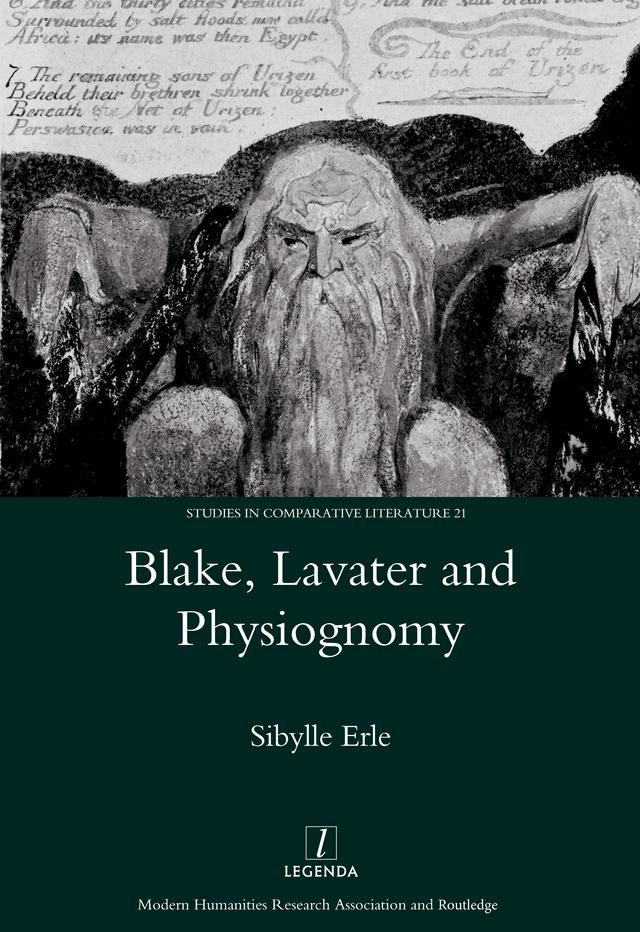
"William Blake never travelled to the continent, yet his creation myth is far more European than has ever been acknowledged. The painter Henry Fuseli introduced Blake to traditional European thinking, and Blake responded to late 18th century body-theory in his Urizen books (1794-95), which emerged from his professional work as a copy-engraver on Henry Hunter's translation of Johann Caspar Lavater's Essays on Physiognomy (1789-98). Lavater's work contains hundreds of portraits and their physiognomical readings. Blake, Fuseli, Joshua Reynolds and their contemporaries took a keen interest in the ideas behind physiognomy in their search for the right balance between good likeness and type in portraits. Blake, Lavater, and Physiognomy demonstrates how the problems occurring during the production of the Hunter translation resonate in Blake's treatment of the Genesis story. Blake takes us back to the creation of the human body, and interrogates the idea that 'God created man after his own likeness.' He introduces the 'Net of Religion', a device which presses the human form into material shape, giving it personality and identity. As Erle shows, Blake's startlingly original take on the creation myth is informed by Lavater's pursuit of physiognomy: the search for divine likeness, traced in the faces of their contemporary men."
Payez facilement par carte, Klarna, Apple Pay ou Google Pay. Pas satisfait ? Vous avez toujours une garantie de remboursement de 14 jours. En savoir plus dans nos conditions. Si vous avez des questions, envoyez-nous un e-mail à hello@memmo.org.
Memmo facilite tes études, où que tu sois dans le monde. On rassemble tes manuels de cours et des outils d'étude intelligents au même endroit : résumés, quiz, podcasts et flashcards. Et il y a Ted, ton compagnon d'étude qui répond à toutes tes questions. Plus de 50 000 étudiants étudient déjà ici – conçu pour t'aider à apprendre plus vite et à moins stresser.
Tu pourrais aussi aimer
Acheter le livre0