
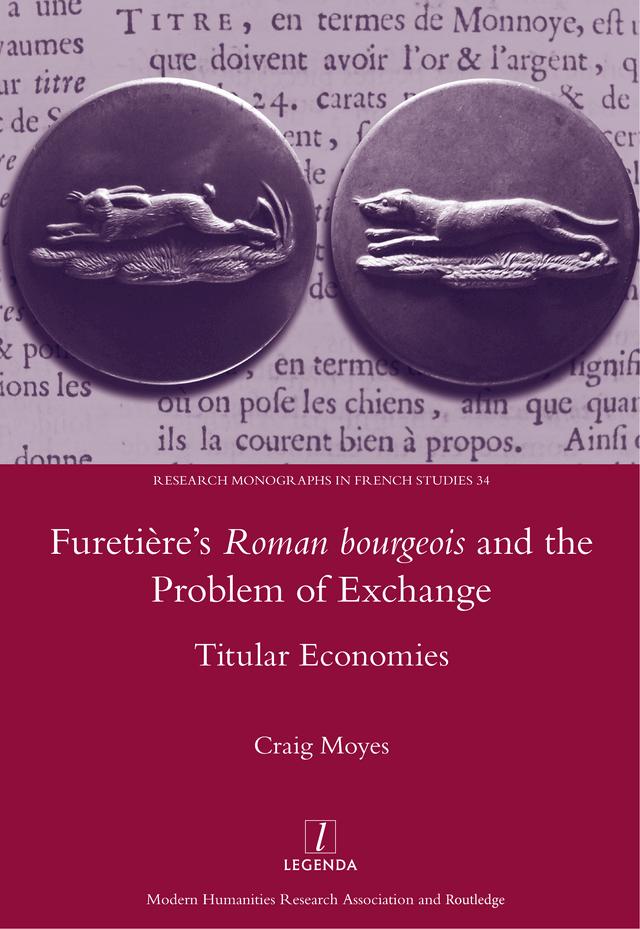
"'If Furetiere (1619-1688) hadn't been friends with Racine and Boileau, if he hadn't been famous for his Dictionary and for his battle with the Academie Francaise, it is unlikely that we would still be speaking of the Roman bourgeois (1666). Its qualities are decidedly few. One cannot even say in its favour that it bears witness to a period and a moment in our literary history.' So writes Antoine Adam in his magisterial history of 17th-century French literature. But whatever one might feel about the aesthetic value of the Roman bourgeois - and following Adam it is usually classified as a precocious though failed example of narrative realism, sadly out of step with the classicism of its time - can we really say that it bears no witness to its period? Craig Moyes shows on the contrary how, within the disarticulated narrative of the Roman bourgeois, Furetiere - the titular abbot, the sitting academician, the secret lexicographer, the experimental novelist - was uniquely placed to explore a changing literary economy marked most spectacularly by the trial of Nicolas Fouquet (1661-1664), the decline of aristocratic largesse, and the subsequent centralization of artistic patronage around the personal reign of Louis XIV and the new administration of Colbert."
Pages: 168
Catégorie: Litteraturvetenskap & Teori
e-ISBN: 9781351192897
Poids d'expédition: 1.2 kg
Expédié sous: 1-2 jours
Payez facilement par carte, Klarna, Apple Pay ou Google Pay. Pas satisfait ? Vous avez toujours une garantie de remboursement de 14 jours. En savoir plus dans nos conditions. Si vous avez des questions, envoyez-nous un e-mail à hello@memmo.org.
Memmo facilite tes études, où que tu sois dans le monde. On rassemble tes manuels de cours et des outils d'étude intelligents au même endroit : résumés, quiz, podcasts et flashcards. Et il y a Ted, ton compagnon d'étude qui répond à toutes tes questions. Plus de 50 000 étudiants étudient déjà ici – conçu pour t'aider à apprendre plus vite et à moins stresser.
Tu pourrais aussi aimer
Acheter le livre0