
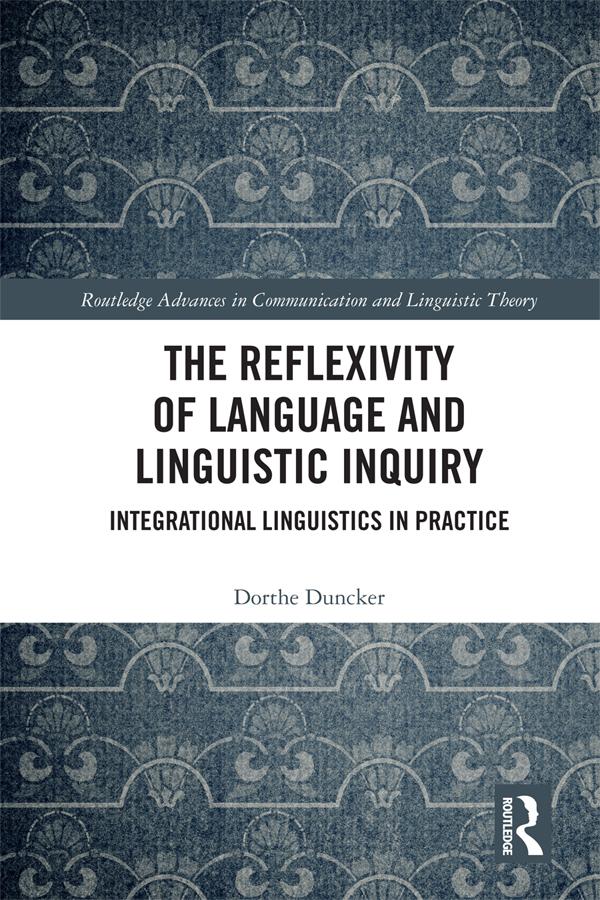
This book explores the reflexivity of language both from the perspective of the lay speaker and the linguistic analyst. Linguistic inquiry is conditional upon linguistic reflexivity, but so is language. Without linguistic reflexivity, we would not be able to make sense of everyday linguistic communication, and the idea of a language would not be conceivable. Not even fundamental notions such as words or meaning would exist. Linguistic reflexivity is a feature of the communication process, and it essentially depends on situated participants and time. It is a defining characteristic of the human language but despite its obvious importance, it is not very well understood theoretically, and it is strangely under-researched empirically. Throughout history and in modern linguistics, it has mostly either been taken for granted, misconstrued, or ignored. Only integrational linguistics fully recognizes its specifically linguistic implications. However, integrational linguistics does not provide the necessary methodological basis for investigating linguistic phenomena empirically. This catch-22 situation means that the goal of the book is twofold: one part is to explore the reflexivity of language theoretically, and the other part is to propose an applied integrational linguistics and to implement this proposal in practice.
Payez facilement par carte, Klarna, Apple Pay ou Google Pay. Pas satisfait ? Vous avez toujours une garantie de remboursement de 14 jours. En savoir plus dans nos conditions. Si vous avez des questions, envoyez-nous un e-mail à hello@memmo.org.
Memmo facilite tes études, où que tu sois dans le monde. On rassemble tes manuels de cours et des outils d'étude intelligents au même endroit : résumés, quiz, podcasts et flashcards. Et il y a Ted, ton compagnon d'étude qui répond à toutes tes questions. Plus de 50 000 étudiants étudient déjà ici – conçu pour t'aider à apprendre plus vite et à moins stresser.