
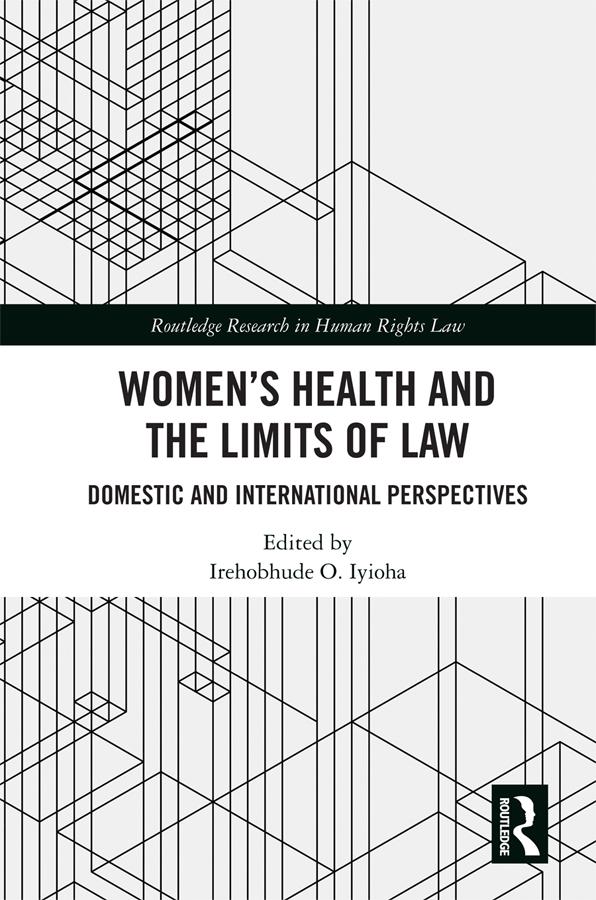
Despite some significant advances in the creation and protection of rights affecting women’s health, these do not always translate into actual health benefits for women. This collection asks: 'What is an effective law and what influences law’s effectiveness or ineffectiveness? What dynamics, elements, and conditions come together to limit law’s capacity to achieve instrumental goals for women’s health and the advancement of women’s health rights?' The book presents an integrated, co-referential and sustained critical discussion of the normative and constitutive reasons for law’s limited effectiveness in the field of women’s health. It offers comprehensive and cohesive explanatory accounts of law’s limits and for the first time in the field, introduces a distinction between formal and substantive effectiveness of laws. Its approach is trans-systemic, multi-jurisdictional and comparative, with a focus on six countries in North America, Europe, Asia, and Africa and international human rights case law based on matters arising from Hungary, Portugal, Spain, Slovakia, the Czech Republic, Peru and Bolivia.
The book will be a valuable resource for educators, students, lawyers, rights advocates and policymakers working in women’s health, socio-legal studies, human rights, feminist legal studies, and legal philosophy more broadly.
Payez facilement par carte, Klarna, Apple Pay ou Google Pay. Pas satisfait ? Vous avez toujours une garantie de remboursement de 14 jours. En savoir plus dans nos conditions. Si vous avez des questions, envoyez-nous un e-mail à hello@memmo.org.
Memmo facilite tes études, où que tu sois dans le monde. On rassemble tes manuels de cours et des outils d'étude intelligents au même endroit : résumés, quiz, podcasts et flashcards. Et il y a Ted, ton compagnon d'étude qui répond à toutes tes questions. Plus de 50 000 étudiants étudient déjà ici – conçu pour t'aider à apprendre plus vite et à moins stresser.