
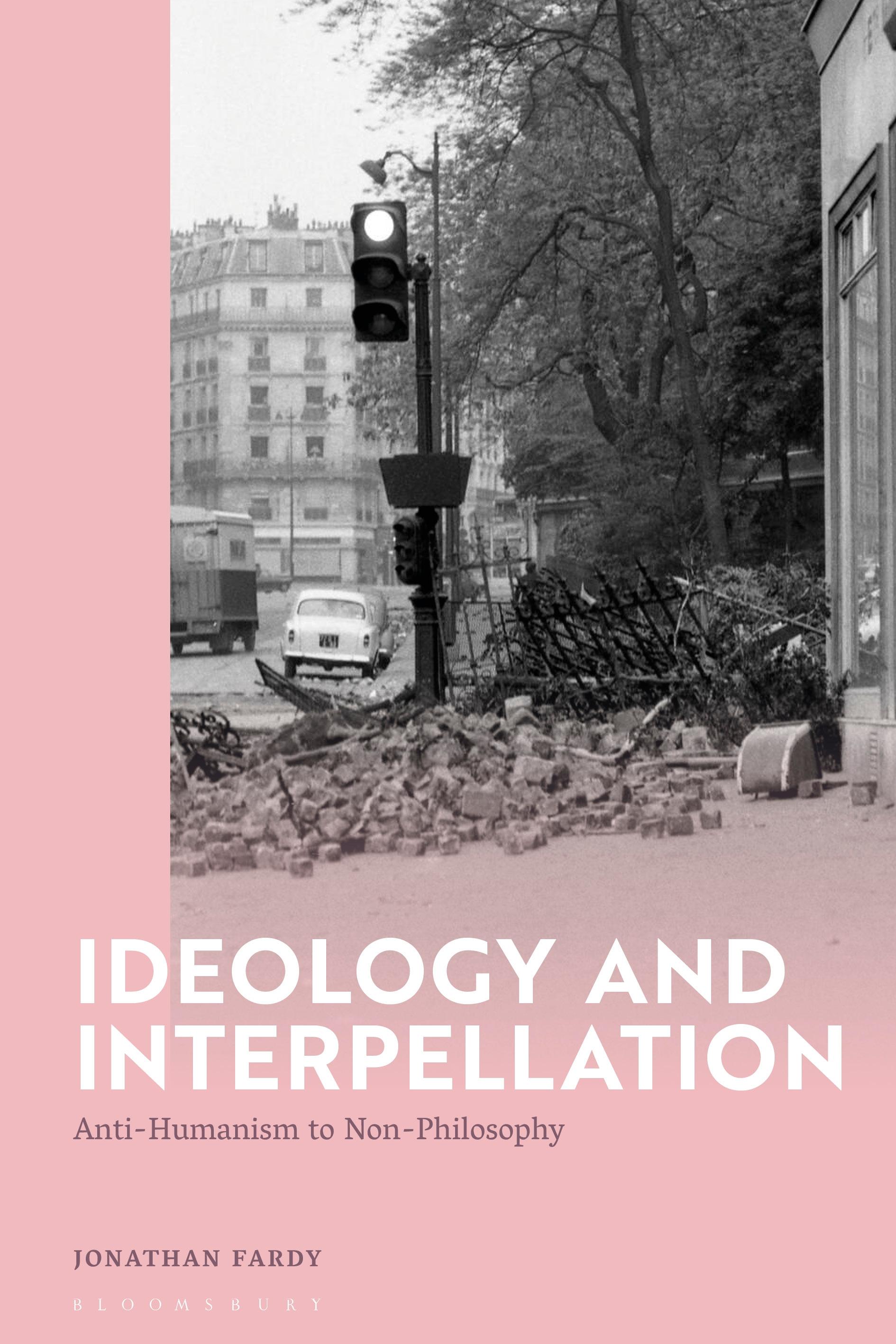
Ideology and Interpellation examines the relation between ideology, the humanist subject, interpellation, and the role of theory. Placing the work of Althusser, Rancière, Baudrillard, and Laruelle into dialogue, this book offers a useful starting point for understanding the demands and possibilities for ideological critique after the deconstruction of the subject.
With chapters devoted to each French theorist's critique, the book first examines the historical and political roots of Althusser's theory of ideology, then placing focus on Rancière's historiographic work in the following chapter. Coming hot on the heels of his blistering critique of his teacher, Althusser, in Althusser's Lesson, Rancière argues that reformers' failure to “interpellate” or recruit workers was due to their work-centric attitude and failure to understand the workers' dreams of lives devoted to unwaged aesthetic and philosophical labour. The fifth chapter shows how Baudrillard disrupts Althusser's fundamental belief that ideology can be unmasked to reveal true structures, by exposing how a society of simulation realizes the untrue by integrating it into the fabric of experience. Finally, Fardy explores how Laruelle calls into question Althusser's presumption that “standard philosophy” is sufficiently guarded against the lures of ideology. On the contrary, Laruelle suggests that this view is in fact that of the ideology of standard philosophy.
Shedding light on the continuing relevance of post-Althusserian Marxist thought, Ideology and Interpellation further demonstrates the need today for a rigorous theory of ideology, traces of which can be found in Althusser's legacy.
With chapters devoted to each French theorist's critique, the book first examines the historical and political roots of Althusser's theory of ideology, then placing focus on Rancière's historiographic work in the following chapter. Coming hot on the heels of his blistering critique of his teacher, Althusser, in Althusser's Lesson, Rancière argues that reformers' failure to “interpellate” or recruit workers was due to their work-centric attitude and failure to understand the workers' dreams of lives devoted to unwaged aesthetic and philosophical labour. The fifth chapter shows how Baudrillard disrupts Althusser's fundamental belief that ideology can be unmasked to reveal true structures, by exposing how a society of simulation realizes the untrue by integrating it into the fabric of experience. Finally, Fardy explores how Laruelle calls into question Althusser's presumption that “standard philosophy” is sufficiently guarded against the lures of ideology. On the contrary, Laruelle suggests that this view is in fact that of the ideology of standard philosophy.
Shedding light on the continuing relevance of post-Althusserian Marxist thought, Ideology and Interpellation further demonstrates the need today for a rigorous theory of ideology, traces of which can be found in Althusser's legacy.
Payez facilement par carte, Klarna, Apple Pay ou Google Pay. Pas satisfait ? Vous avez toujours une garantie de remboursement de 14 jours. En savoir plus dans nos conditions. Si vous avez des questions, envoyez-nous un e-mail à hello@memmo.org.
Memmo facilite tes études, où que tu sois dans le monde. On rassemble tes manuels de cours et des outils d'étude intelligents au même endroit : résumés, quiz, podcasts et flashcards. Et il y a Ted, ton compagnon d'étude qui répond à toutes tes questions. Plus de 50 000 étudiants étudient déjà ici – conçu pour t'aider à apprendre plus vite et à moins stresser.