
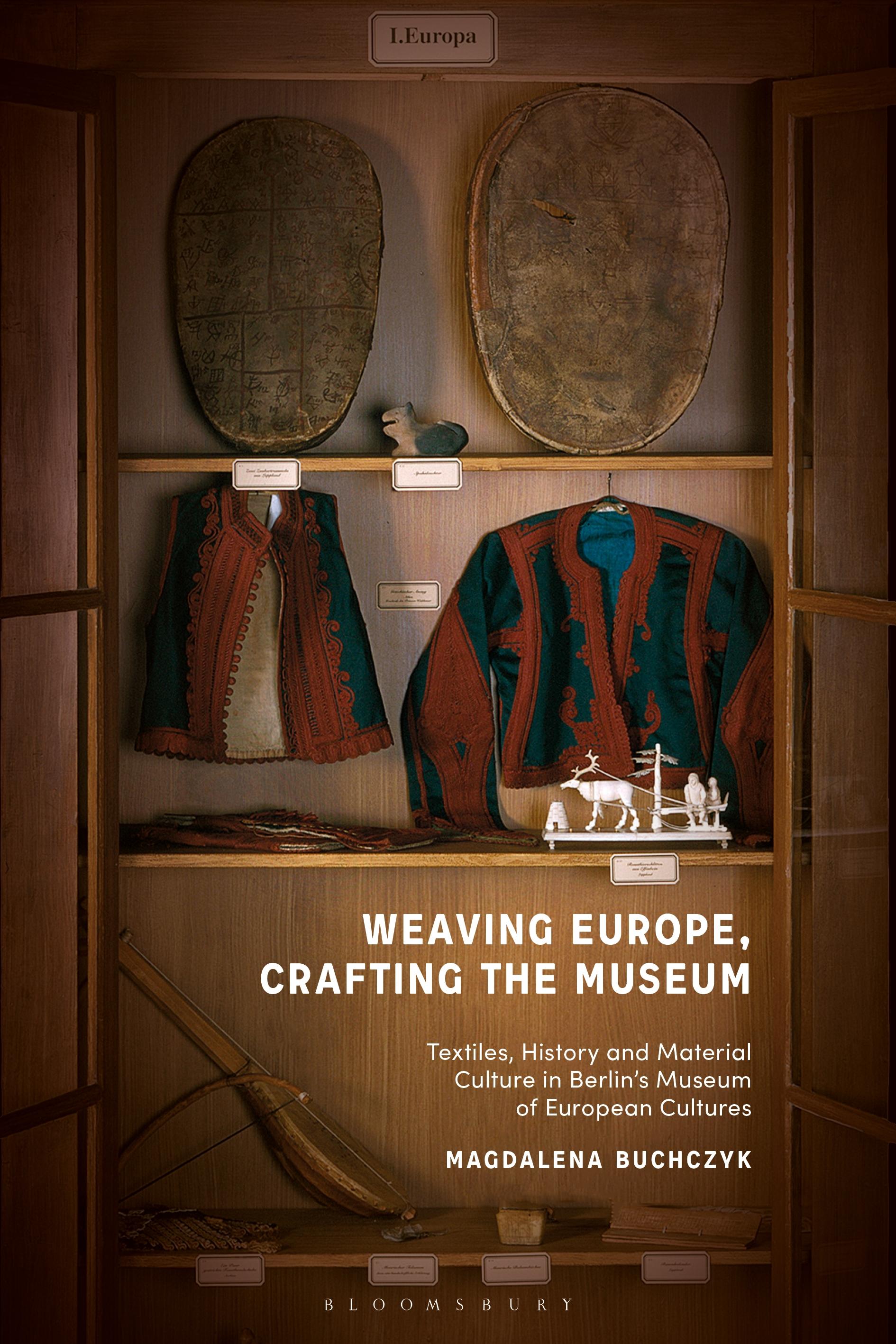
Weaving Europe, Crafting the Museum delves into the history and the changing material culture in Europe through the stories of a basket, a carpet, a waistcoat, a uniform, and a dress. The focus on the objects from the collection of the Museum of European Cultures in Berlin offers an innovative and challenging way of understanding textile culture and museums. The book shows that textiles can be simultaneously used as the material object of research, and as a lens through which we can view museums. In doing so, the book fills a major gap by placing textile knowledge back into the museum.
Each chapter focuses on one object story and can be read individually. Swooping from 19th-century wax figure cabinets, Nazi-era collections, Cold War exhibitions in East and West Berlin, and institutional reshuffling after German unification, it reveals the dramatically changing story of the museum and its collection. Based on research with museum curators, makers and users of the textiles in Italy and Germany, Poland and Romania, the book provides intimate insights into how objects are mobilised to very different social and political effects. It sheds new light on movements across borders, political uses of textiles by fascist and communist regimes, the objects' fall into oblivion, as well as their heritage and tourist afterlives. Addressing this complex museum legacy, the book suggests new pathways to prefigure the future.
Featuring new archival and ethnographic research, evocative examples and images, it is an essential read for students of textile and material culture, museum and curatorial studies as well as anyone interested in history, heritage and craft.
Each chapter focuses on one object story and can be read individually. Swooping from 19th-century wax figure cabinets, Nazi-era collections, Cold War exhibitions in East and West Berlin, and institutional reshuffling after German unification, it reveals the dramatically changing story of the museum and its collection. Based on research with museum curators, makers and users of the textiles in Italy and Germany, Poland and Romania, the book provides intimate insights into how objects are mobilised to very different social and political effects. It sheds new light on movements across borders, political uses of textiles by fascist and communist regimes, the objects' fall into oblivion, as well as their heritage and tourist afterlives. Addressing this complex museum legacy, the book suggests new pathways to prefigure the future.
Featuring new archival and ethnographic research, evocative examples and images, it is an essential read for students of textile and material culture, museum and curatorial studies as well as anyone interested in history, heritage and craft.
Payez facilement par carte, Klarna, Apple Pay ou Google Pay. Pas satisfait ? Vous avez toujours une garantie de remboursement de 14 jours. En savoir plus dans nos conditions. Si vous avez des questions, envoyez-nous un e-mail à hello@memmo.org.
Memmo facilite tes études, où que tu sois dans le monde. On rassemble tes manuels de cours et des outils d'étude intelligents au même endroit : résumés, quiz, podcasts et flashcards. Et il y a Ted, ton compagnon d'étude qui répond à toutes tes questions. Plus de 50 000 étudiants étudient déjà ici – conçu pour t'aider à apprendre plus vite et à moins stresser.