
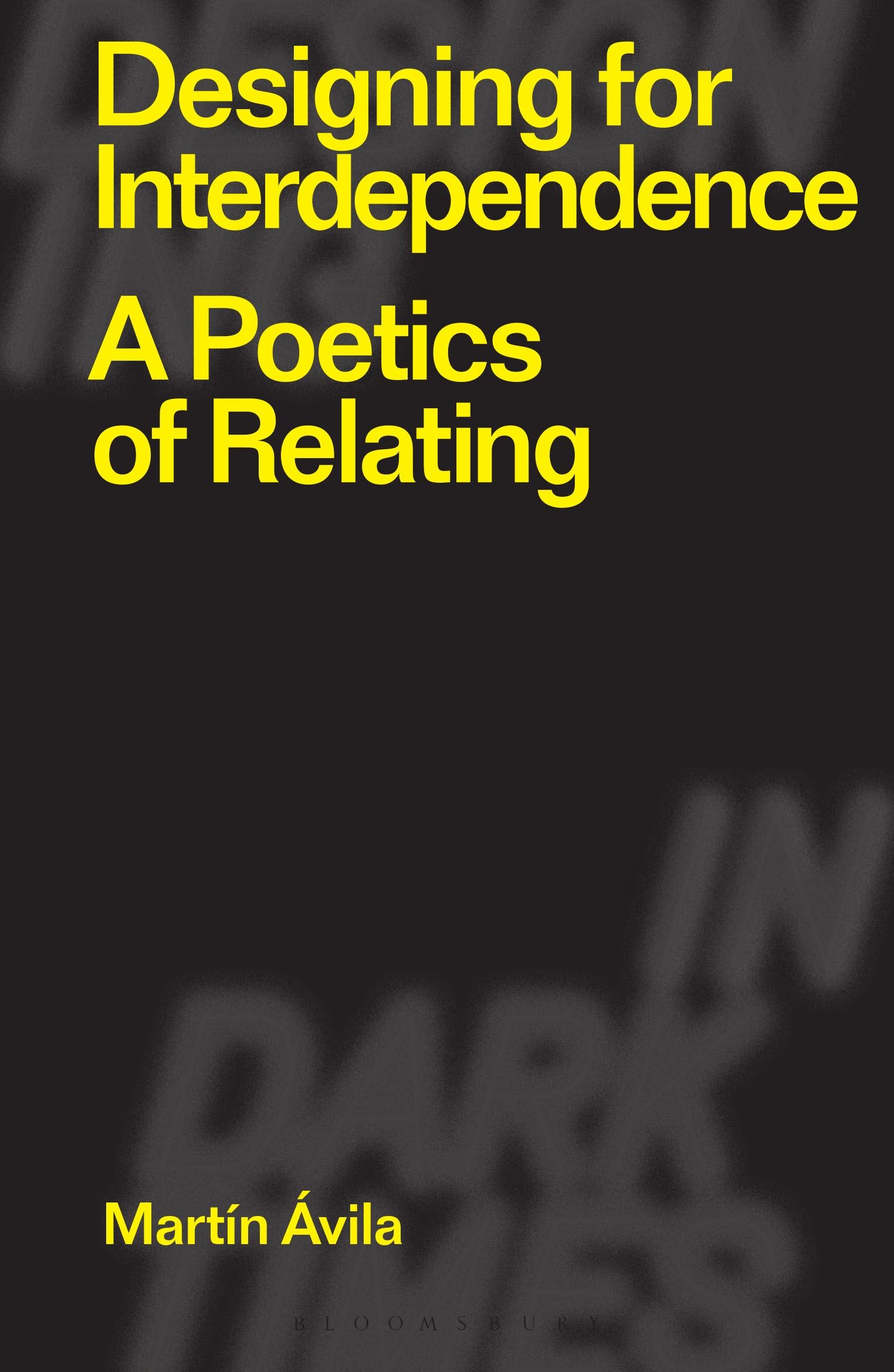
Challenging the dominant design paradigm that centres humanity in its practice, Designing for Interdependence puts forward an ecocentric mode of designing that privileges a harmonious relationship between all life forms that share our planet. This book is about the practice of designing and design's capacity to relate (or not) to beings of all kinds, human and others, in ways that are life-affirming.
Sensitive to power differentials and the responsibility that this entails, Martín Ávila develops the notion of alter-natives, a concept that exposes the alterity of artificial things and the potential of these things to participate in the sustainment of natural environments. He proposes a design practice that encompasses humans, artificial things and other-than-human species in a 'poetics of relating', and provides methods that support the rewilding necessary for maintaining cultural and biological diversity and the stabilization of planetary dynamics. The book features real-life project case studies that illustrate some of the political-ecological implications of an ecocentric paradigm, which can help us to imagine alternative modes of relating to local environments and alternative modes of inter-species cohabitation.
Avoiding dualistic thinking and the dichotomies harmful-benefit, construction-destruction, natural-artificial and life-death, Ávila pursues the work of caring for how our mattering through design can become constructive in creating more-than-human ecologies.
Sensitive to power differentials and the responsibility that this entails, Martín Ávila develops the notion of alter-natives, a concept that exposes the alterity of artificial things and the potential of these things to participate in the sustainment of natural environments. He proposes a design practice that encompasses humans, artificial things and other-than-human species in a 'poetics of relating', and provides methods that support the rewilding necessary for maintaining cultural and biological diversity and the stabilization of planetary dynamics. The book features real-life project case studies that illustrate some of the political-ecological implications of an ecocentric paradigm, which can help us to imagine alternative modes of relating to local environments and alternative modes of inter-species cohabitation.
Avoiding dualistic thinking and the dichotomies harmful-benefit, construction-destruction, natural-artificial and life-death, Ávila pursues the work of caring for how our mattering through design can become constructive in creating more-than-human ecologies.
Payez facilement par carte, Klarna, Apple Pay ou Google Pay. Pas satisfait ? Vous avez toujours une garantie de remboursement de 14 jours. En savoir plus dans nos conditions. Si vous avez des questions, envoyez-nous un e-mail à hello@memmo.org.
Memmo facilite tes études, où que tu sois dans le monde. On rassemble tes manuels de cours et des outils d'étude intelligents au même endroit : résumés, quiz, podcasts et flashcards. Et il y a Ted, ton compagnon d'étude qui répond à toutes tes questions. Plus de 50 000 étudiants étudient déjà ici – conçu pour t'aider à apprendre plus vite et à moins stresser.