
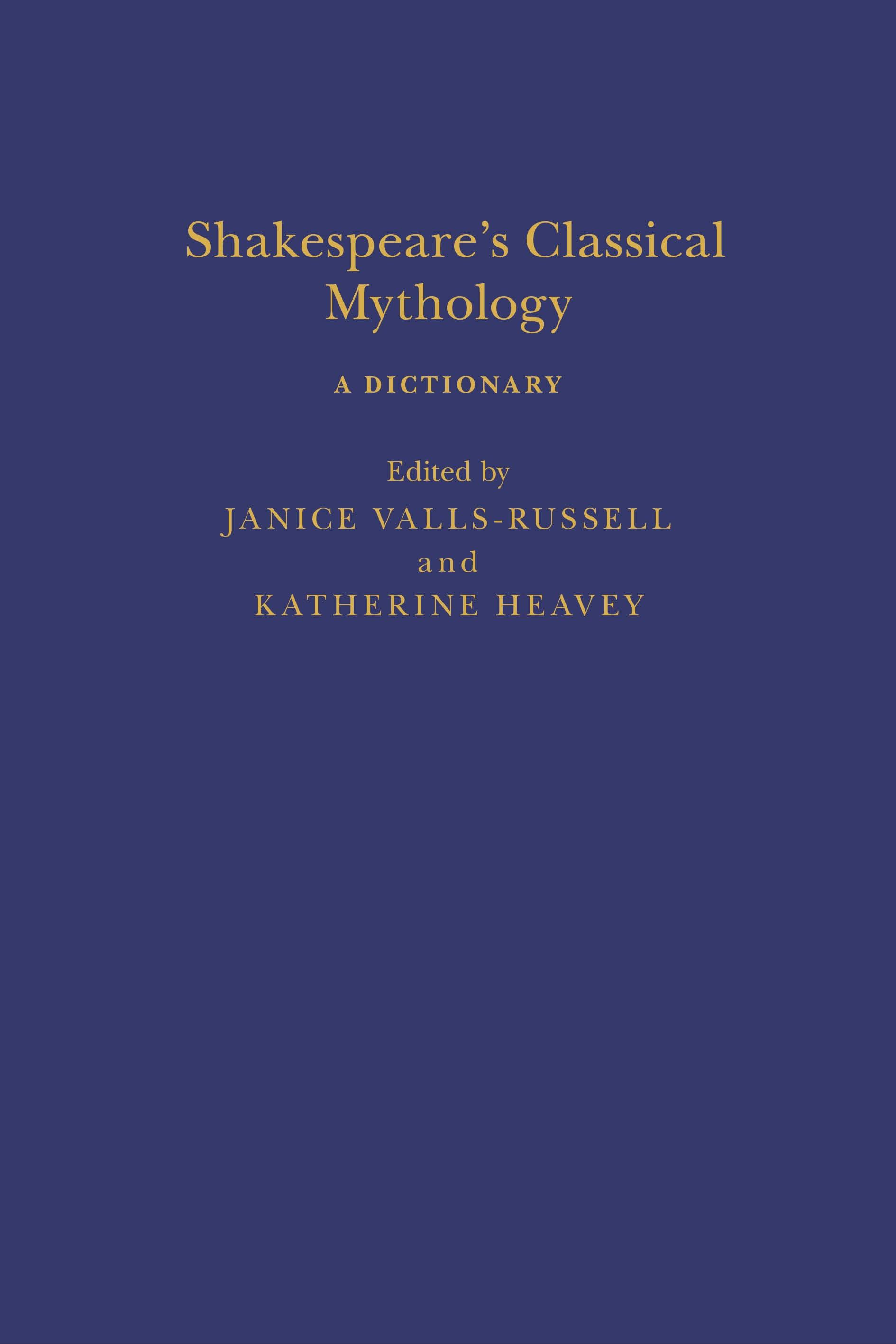
Why does Bassanio compare himself to Jason? What is Hecuba to Hamlet? Is the mechanicals' staging of the Pyramus and Thisbe story funny or sad?
This dictionary elucidates Shakespeare's use of mythological references in an early modern context, while bringing them to life for today's audiences and readers, at a time of renewed critical interest in the reception of the classics and fascination with classical mythology in popular culture. It is also a precious tool for practitioners who may not always know quite what to make of mythological references.
Mythological figures, creatures, places and stories crowd Shakespeare's plays and poems, featuring as allusions, poetic analogies, inset shows, scene settings and characters or plots in their own right. Most of these references were familiar to Shakespeare's spectators and readers, who knew them from the writings of Ovid, Virgil and other classical authors, or indirectly through translations, commentaries, ballads and iconography.
This dictionary illustrates how, far from being isolated, a mythological reference may resonate with the poetics of the text and its structure, cast light on characters and contexts, and may therefore be worth exploring onstage in a variety of ways. The 200 headings correspond to words and names actually used by Shakespeare: individual figures (Dido, Venus, Hercules), categories (Amazons, Centaurs, nymphs, satyrs), places (Colchos, Troy). Medium and longer entries also cover early modern usage and critical analysis in a cross-disciplinary approach that includes reception, textual, performance, gender and political studies.
This dictionary elucidates Shakespeare's use of mythological references in an early modern context, while bringing them to life for today's audiences and readers, at a time of renewed critical interest in the reception of the classics and fascination with classical mythology in popular culture. It is also a precious tool for practitioners who may not always know quite what to make of mythological references.
Mythological figures, creatures, places and stories crowd Shakespeare's plays and poems, featuring as allusions, poetic analogies, inset shows, scene settings and characters or plots in their own right. Most of these references were familiar to Shakespeare's spectators and readers, who knew them from the writings of Ovid, Virgil and other classical authors, or indirectly through translations, commentaries, ballads and iconography.
This dictionary illustrates how, far from being isolated, a mythological reference may resonate with the poetics of the text and its structure, cast light on characters and contexts, and may therefore be worth exploring onstage in a variety of ways. The 200 headings correspond to words and names actually used by Shakespeare: individual figures (Dido, Venus, Hercules), categories (Amazons, Centaurs, nymphs, satyrs), places (Colchos, Troy). Medium and longer entries also cover early modern usage and critical analysis in a cross-disciplinary approach that includes reception, textual, performance, gender and political studies.
Pages: 496
Catégorie: Litteraturvetenskap & Teori
e-ISBN: 9781350125889
Poids d'expédition: 1.2 kg
Expédié sous: 1-2 jours
Payez facilement par carte, Klarna, Apple Pay ou Google Pay. Pas satisfait ? Vous avez toujours une garantie de remboursement de 14 jours. En savoir plus dans nos conditions. Si vous avez des questions, envoyez-nous un e-mail à hello@memmo.org.
Memmo facilite tes études, où que tu sois dans le monde. On rassemble tes manuels de cours et des outils d'étude intelligents au même endroit : résumés, quiz, podcasts et flashcards. Et il y a Ted, ton compagnon d'étude qui répond à toutes tes questions. Plus de 50 000 étudiants étudient déjà ici – conçu pour t'aider à apprendre plus vite et à moins stresser.