
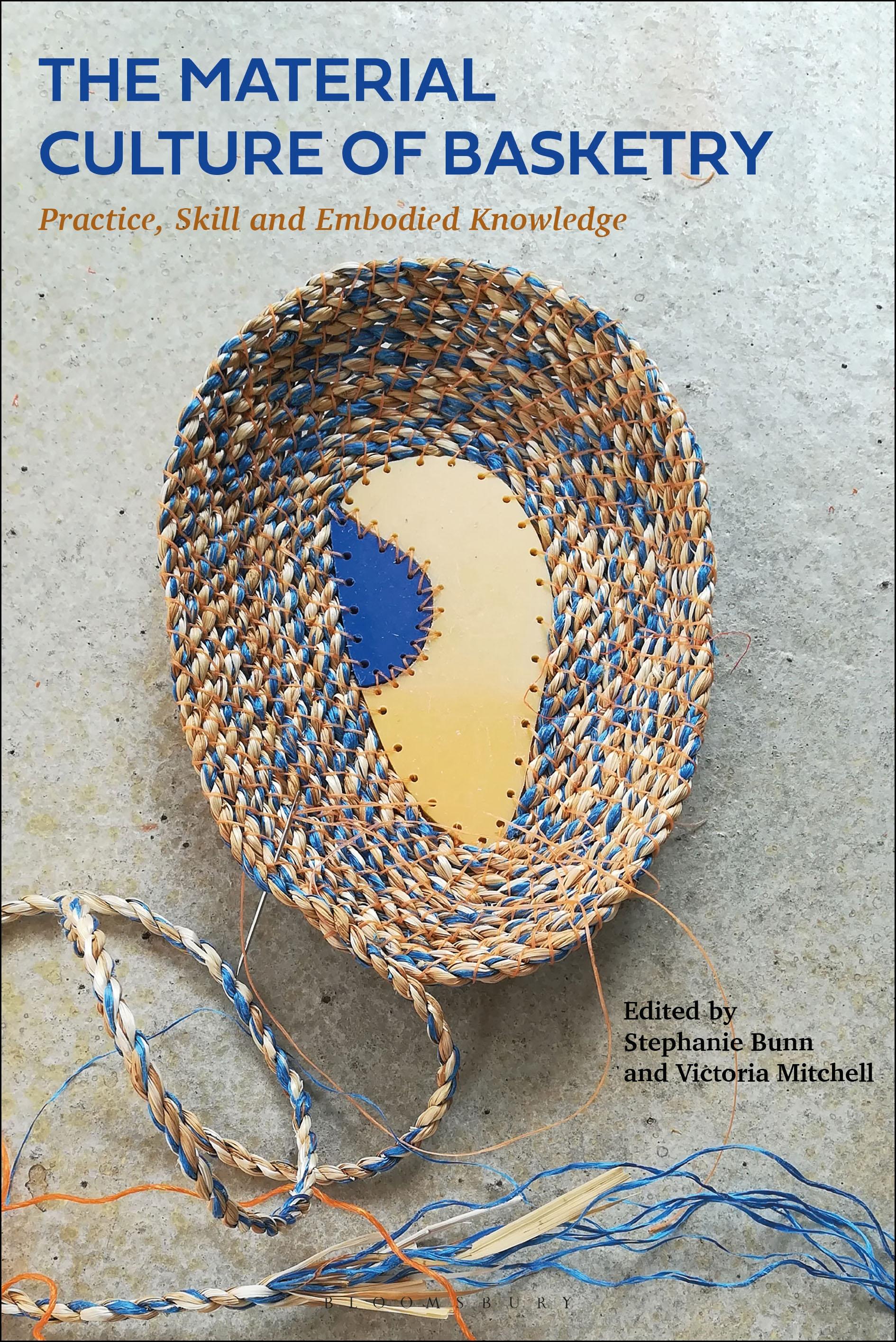
The Material Culture of Basketry celebrates basketry as a culturally significant skilled practice and as a theoretically rich discipline which has much to offer contemporary society. While sometimes understudied and underappreciated, it has much in common with mathematics and engineering, art, craft and design, and can also act as a socially beneficial source of skill and care.
Contributors show how local knowledge of materials, plants and place are central to the craft. Case studies include the skill in weaverbird nest building (challenging how we perceive learning in craft and nature), an engineer's perspective on twining Peruvian grass bridges, and the local knowledge embodied in Pacific plaited patterns and knots. Photo-essays explore materials and techniques from the point of view of artists, anthropologists and mathematicians, revealing how the structure and skill in basketwork illustrate a significant form of textile technology. Thus, the book argues that the textures, patterns and geometric forms that emerge through basketwork reflect an embodied knowledge which expresses mathematical and engineering comprehension.
The therapeutic value of the craft is recognised through a selection of case studies which consider basketry as a healing process for patients with brain injury, mental health problems, and as a memory aid for people living with dementia. This reclaims basketry's significant role in occupational therapy as an agent of recovery and well–being. Finally, basketry's inherently sustainable nature is also considered, demonstrating the continuation of basketry in spite of handwork's general decline and profiling new and recycled materials. Above all the book envisages basketry as an intellectually rewarding means of knowing. It presents the craft as embodying care for skilled making and for the social and natural environments in which it flourishes.
Contributors show how local knowledge of materials, plants and place are central to the craft. Case studies include the skill in weaverbird nest building (challenging how we perceive learning in craft and nature), an engineer's perspective on twining Peruvian grass bridges, and the local knowledge embodied in Pacific plaited patterns and knots. Photo-essays explore materials and techniques from the point of view of artists, anthropologists and mathematicians, revealing how the structure and skill in basketwork illustrate a significant form of textile technology. Thus, the book argues that the textures, patterns and geometric forms that emerge through basketwork reflect an embodied knowledge which expresses mathematical and engineering comprehension.
The therapeutic value of the craft is recognised through a selection of case studies which consider basketry as a healing process for patients with brain injury, mental health problems, and as a memory aid for people living with dementia. This reclaims basketry's significant role in occupational therapy as an agent of recovery and well–being. Finally, basketry's inherently sustainable nature is also considered, demonstrating the continuation of basketry in spite of handwork's general decline and profiling new and recycled materials. Above all the book envisages basketry as an intellectually rewarding means of knowing. It presents the craft as embodying care for skilled making and for the social and natural environments in which it flourishes.
Pages: 312
Catégorie: Samhällsvetenskap
e-ISBN: 9781350094048
Poids d'expédition: 1.2 kg
Expédié sous: 1-2 jours
Payez facilement par carte, Klarna, Apple Pay ou Google Pay. Pas satisfait ? Vous avez toujours une garantie de remboursement de 14 jours. En savoir plus dans nos conditions. Si vous avez des questions, envoyez-nous un e-mail à hello@memmo.org.
Memmo facilite tes études, où que tu sois dans le monde. On rassemble tes manuels de cours et des outils d'étude intelligents au même endroit : résumés, quiz, podcasts et flashcards. Et il y a Ted, ton compagnon d'étude qui répond à toutes tes questions. Plus de 50 000 étudiants étudient déjà ici – conçu pour t'aider à apprendre plus vite et à moins stresser.