
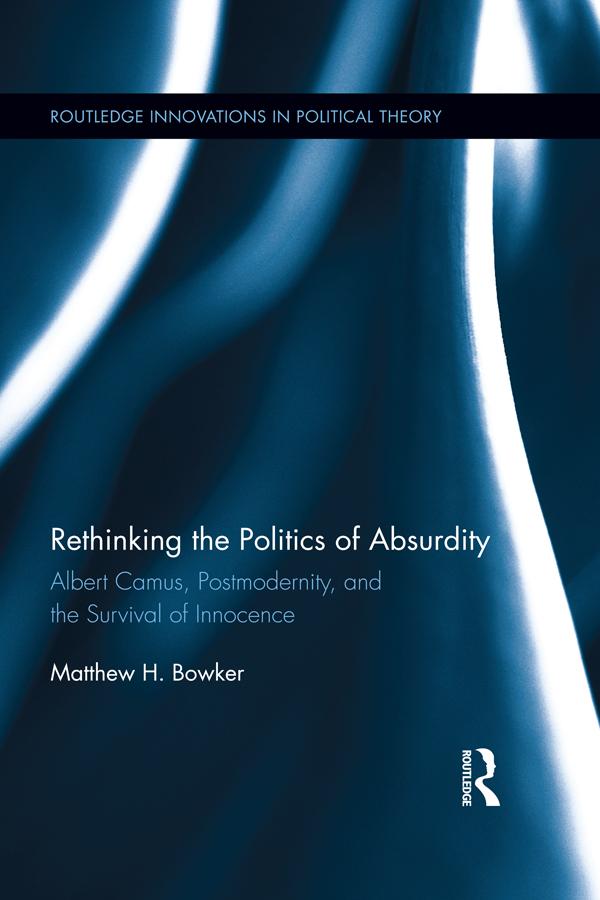
What does it mean to describe something or someone as absurd? Why did absurd philosophy and literature become so popular amidst the violent conflicts and terrors of the mid- to late-twentieth century? Is it possible to understand absurdity not as a feature of events, but as a psychological posture or stance? If so, what are the objectives, dynamics, and repercussions of the absurd stance? And in what ways has the absurd stance continued to shape postmodern thought and contemporary culture?
In Rethinking the Politics of Absurdity, Matthew H. Bowker offers a surprising account of absurdity as a widespread endeavor to make parts of our experience meaningless. In the last century, he argues, fears about subjects’ destructive desires have combined with fears about rationality in a way that has made the absurd stance seem attractive. Drawing upon diverse sources from philosophy, literature, politics, psychoanalysis, theology, and contemporary culture, Bowker identifies the absurd effort to make aspects of our histories, our selves, and our public projects meaningless with postmodern revolts against reason and subjectivity. Weaving together analyses of the work of Albert Camus, Georges Bataille, Judith Butler, Emmanuel Levinas, and others with interview data and popular narratives of apocalypse and survival, Bowker shows that the absurd stance and the postmodern revolt invite a kind of bargain, in which meaning is sacrificed in exchange for the survival of innocence. Bowker asks us to consider that the very premise of this bargain is false: that ethical subjects and healthy communities cannot be created in absurdity. Instead, we must make meaningful even the most shocking losses, terrors, and destructive powers with which we live.
Bowker's book will be of interest to scholars and practitioners in the fields of political science, philosophy, literature, psychoanalysis, sociology, and cultural studies.
Payez facilement par carte, Klarna, Apple Pay ou Google Pay. Pas satisfait ? Vous avez toujours une garantie de remboursement de 14 jours. En savoir plus dans nos conditions. Si vous avez des questions, envoyez-nous un e-mail à hello@memmo.org.
Memmo facilite tes études, où que tu sois dans le monde. On rassemble tes manuels de cours et des outils d'étude intelligents au même endroit : résumés, quiz, podcasts et flashcards. Et il y a Ted, ton compagnon d'étude qui répond à toutes tes questions. Plus de 50 000 étudiants étudient déjà ici – conçu pour t'aider à apprendre plus vite et à moins stresser.