
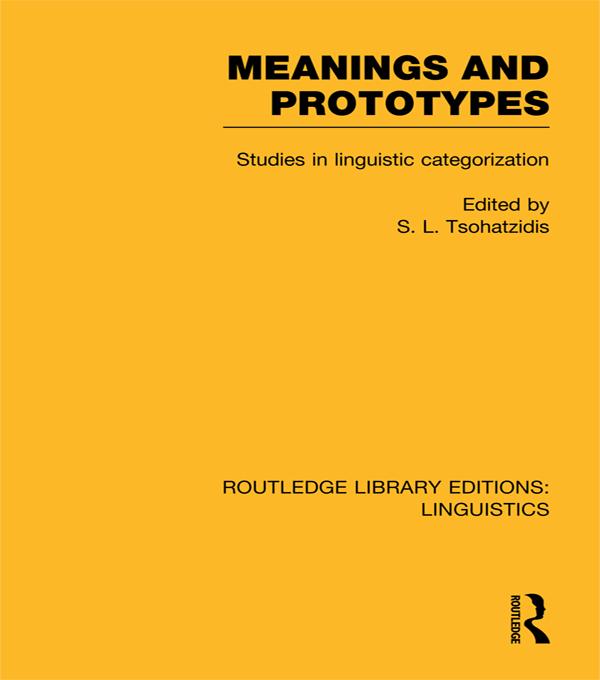
There are fewer distinctions in any language than there are distinct things in the universe. If, therefore, languages are ways of representing the universe, a primary function of their elements must be to allow the much more varied kinds of elements out of which the universe is made to be categorized in specific ways. A prototype approach to linguistic categories is a particular way of answering the question of how this categorization operates. It involves two claims. First, that linguistic categorization exploits principles that are not specific to language but characterize most, if not all, processes of cognition. Secondly, that a basic principle by which cognitive and linguistic categories are organized is the prototype principle, which assigns elements to a category not because they exemplify properties that are absolutely required of each one of its members, but because they exhibit, in varying degrees, certain types of similarity with a particular category member which has been established as the best example (or: prototype) of its kind.
The development of the prototype approach into a satisfactory body of theory obviously requires both that its empirical base be enriched, and that its conceptual foundations be clarified. These are the areas where this volume, in its 26 essays, makes original contributions. The first two parts contain discussions in which various kinds of linguistic phenomena are analysed in ways that make essential use of prototype notions. The last two parts contain discussions in which prototype notions themselves become the object, rather than the instrument, of analytical scrutiny.
Payez facilement par carte, Klarna, Apple Pay ou Google Pay. Pas satisfait ? Vous avez toujours une garantie de remboursement de 14 jours. En savoir plus dans nos conditions. Si vous avez des questions, envoyez-nous un e-mail à hello@memmo.org.
Memmo facilite tes études, où que tu sois dans le monde. On rassemble tes manuels de cours et des outils d'étude intelligents au même endroit : résumés, quiz, podcasts et flashcards. Et il y a Ted, ton compagnon d'étude qui répond à toutes tes questions. Plus de 50 000 étudiants étudient déjà ici – conçu pour t'aider à apprendre plus vite et à moins stresser.