
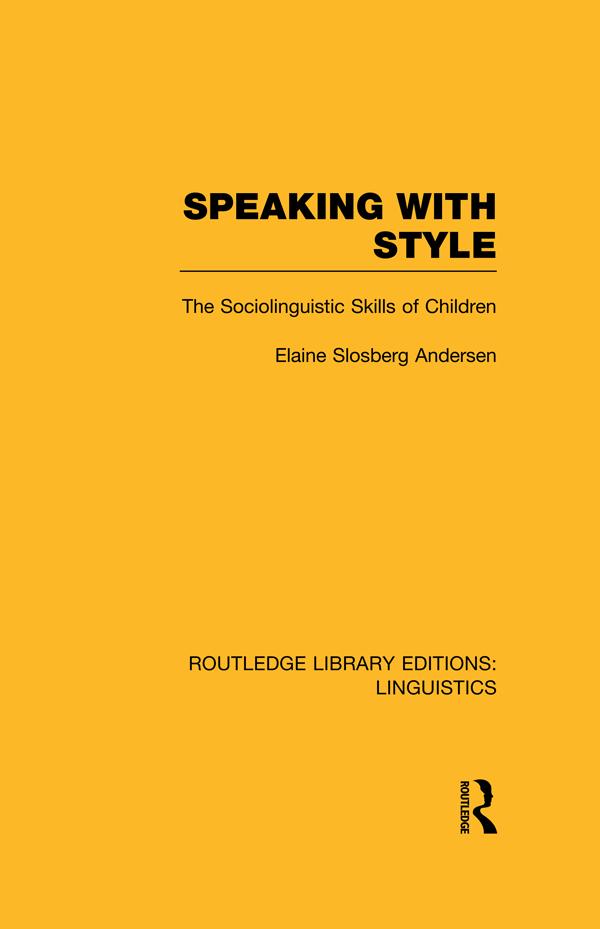
In acquiring communicative competence, children must learn to speak not only grammatically but also appropriately. Although rules for appropriate language use may vary from culture to culture, they are usually sensitive across languages to many of the same factors, including the context and the topic of the discourse, and the sex, age, familiarity and relative status of the speaker and the listener. There is available detailed evidence of the ways in which adults consistently modify their speech to foreigners, of phonological, syntactic, and lexical markings of language in professional settings, and of differences in men’s and women’s speech that are tied to their roles in society.
This book examines young children’s knowledge of the sociolinguistic rules that govern appropriate language use, exploring (i) the repertoire of registers (ie speech varieties) that young children possess; (ii) the linguistic devices that they use to mark distinct registers; (iii) the way their skill in using these registers develops.
Payez facilement par carte, Klarna, Apple Pay ou Google Pay. Pas satisfait ? Vous avez toujours une garantie de remboursement de 14 jours. En savoir plus dans nos conditions. Si vous avez des questions, envoyez-nous un e-mail à hello@memmo.org.
Memmo facilite tes études, où que tu sois dans le monde. On rassemble tes manuels de cours et des outils d'étude intelligents au même endroit : résumés, quiz, podcasts et flashcards. Et il y a Ted, ton compagnon d'étude qui répond à toutes tes questions. Plus de 50 000 étudiants étudient déjà ici – conçu pour t'aider à apprendre plus vite et à moins stresser.