
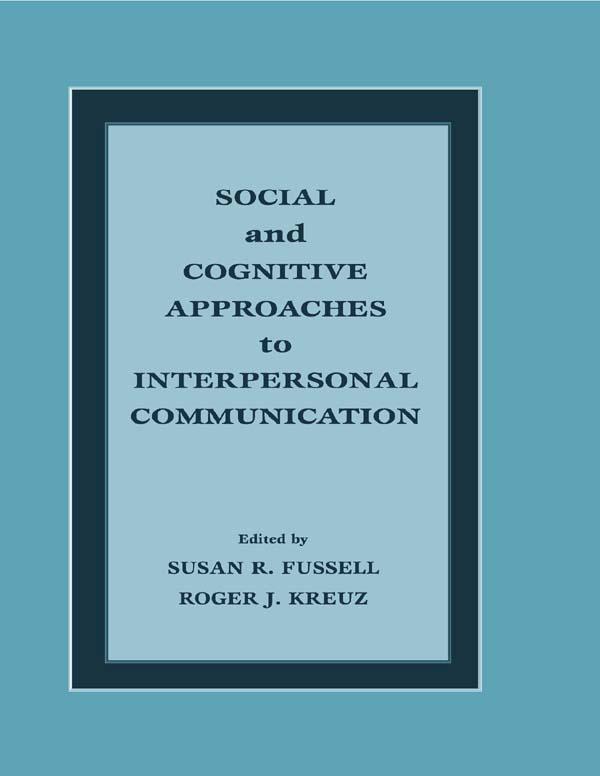
Historically, the social aspects of language use have been considered the domain of social psychology, while the underlying psycholinguistic mechanisms have been the purview of cognitive psychology. Recently, it has become increasingly clear that these two dimensions are highly interrelated: cognitive mechanisms underlying speech production and comprehension interact with social psychological factors, such as beliefs about one's interlocutors and politeness norms, and with the dynamics of the conversation itself, to produce shared meaning. This realization has led to an exciting body of research integrating the social and cognitive dimensions which has greatly increased our understanding of human language use.
Each chapter in this volume demonstrates how the theoretical approaches and research methods of social and cognitive psychology can be successfully interwoven to provide insight into one or more fundamental questions about the process of interpersonal communication. The topics under investigation include the nature and role of speaker intentions in the communicative process, the production and comprehension of indirect speech and figurative language, perspective-taking and conversational collaboration, and the relationships between language, cognition, culture, and social interaction. The book will be of interest to all those who study interpersonal language use: social and cognitive psychologists, theoretical and applied linguists, and communication researchers.
Payez facilement par carte, Klarna, Apple Pay ou Google Pay. Pas satisfait ? Vous avez toujours une garantie de remboursement de 14 jours. En savoir plus dans nos conditions. Si vous avez des questions, envoyez-nous un e-mail à hello@memmo.org.
Memmo facilite tes études, où que tu sois dans le monde. On rassemble tes manuels de cours et des outils d'étude intelligents au même endroit : résumés, quiz, podcasts et flashcards. Et il y a Ted, ton compagnon d'étude qui répond à toutes tes questions. Plus de 50 000 étudiants étudient déjà ici – conçu pour t'aider à apprendre plus vite et à moins stresser.