
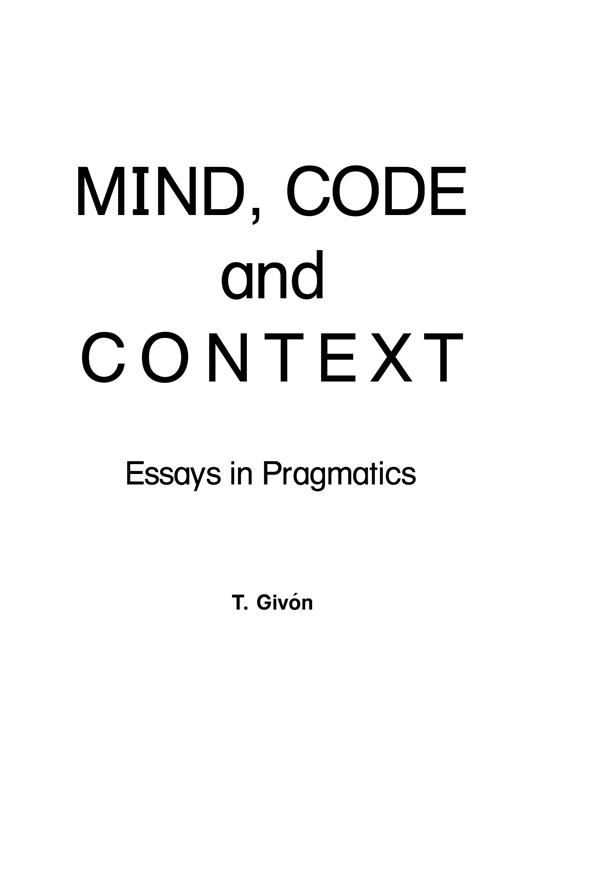
Scholars concerned with the phenomenon of mind have searched through history for a principled yet non-reductionist approach to the study of knowledge, communication, and behavior. Pragmatics has been a recurrent theme in Western epistemology, tracing itself back from pre-Socratic dialectics and Aristotle's bio- functionalism, all the way to Wittgenstein's content-dependent semantics.
This book's treatment of pragmatics as an analytic method focuses on the central role of context in determining the perception, organization, and communication of experience. As a bioadaptive strategy, pragmatics straddles the middle ground between absolute categories and the non-discrete gradation of experience, reflecting closely the organism's own evolutionary compromises. In parallel, pragmatic reasoning can be shown to play a pivotal role in the process of empirical science, through the selection of relevant facts, the abduction of likely hypotheses, and the construction of non-trivial explanations.
In this volume, Professor Givon offers pragmatics as both an analytic method and a strategic intellectual framework. He points out its relevance to our understanding of traditional problems in philosophy, anthropology, linguistics, cognitive psychology, neuro-biology, and evolution. Finally, the application of pragmatics to the study of the mind and behavior constitutes an implicit challenge to the current tenets of artificial intelligence.
Payez facilement par carte, Klarna, Apple Pay ou Google Pay. Pas satisfait ? Vous avez toujours une garantie de remboursement de 14 jours. En savoir plus dans nos conditions. Si vous avez des questions, envoyez-nous un e-mail à hello@memmo.org.
Memmo facilite tes études, où que tu sois dans le monde. On rassemble tes manuels de cours et des outils d'étude intelligents au même endroit : résumés, quiz, podcasts et flashcards. Et il y a Ted, ton compagnon d'étude qui répond à toutes tes questions. Plus de 50 000 étudiants étudient déjà ici – conçu pour t'aider à apprendre plus vite et à moins stresser.