
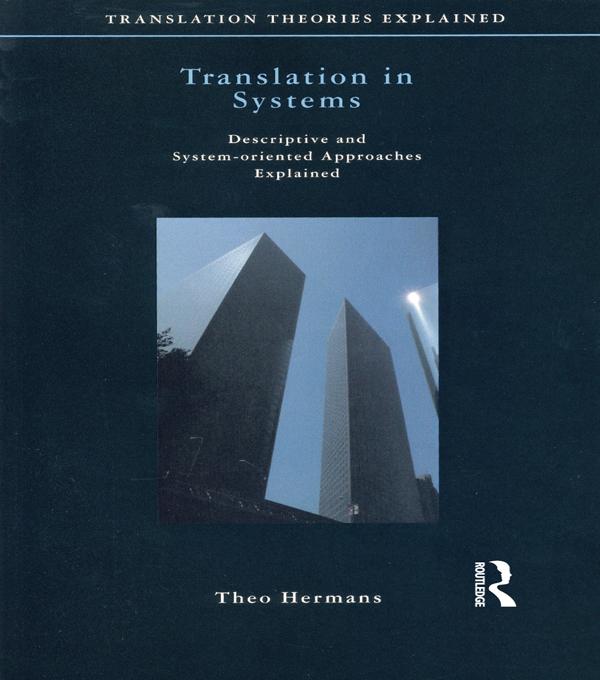
The notion of systems has helped revolutionize translation studies since the 1970s. As a key part of many descriptive approaches, it has broken with the prescriptive focus on what translation should be, encouraging researchers to ask what translation does in specific cultural settings. From his privileged position as a direct participant in these developments, Theo Hermans explains how contemporary descriptive approaches came about, what the basic ideas were, and how those ideas have evolved over time. His discussion addresses the fundamental problems of translation norms, equivalence, polysystems and social systems, covering not only the work of Levý, Holmes, Even-Zohar, Toury, Lefevere, Lambert, Van Leuven-Zwart, Dhulst and others, but also giving special attention to recent contributions derived from Pierre Bourdieu and Niklas Luhmann. An added focus on practical questions of how to investigate translation (problems of definition, description, assessment of readerships, etc.) makes this book essential reading for graduate students and indeed any researchers in the field. Hermans' account of descriptive translation studies is both informed and critical. At the same time, he demonstrates the strength of the basic concepts, which have shown considerable vitality in their evolution and adaptation to the debates of the present day.
Payez facilement par carte, Klarna, Apple Pay ou Google Pay. Pas satisfait ? Vous avez toujours une garantie de remboursement de 14 jours. En savoir plus dans nos conditions. Si vous avez des questions, envoyez-nous un e-mail à hello@memmo.org.
Memmo facilite tes études, où que tu sois dans le monde. On rassemble tes manuels de cours et des outils d'étude intelligents au même endroit : résumés, quiz, podcasts et flashcards. Et il y a Ted, ton compagnon d'étude qui répond à toutes tes questions. Plus de 50 000 étudiants étudient déjà ici – conçu pour t'aider à apprendre plus vite et à moins stresser.
Tu pourrais aussi aimer
Acheter le livre0