
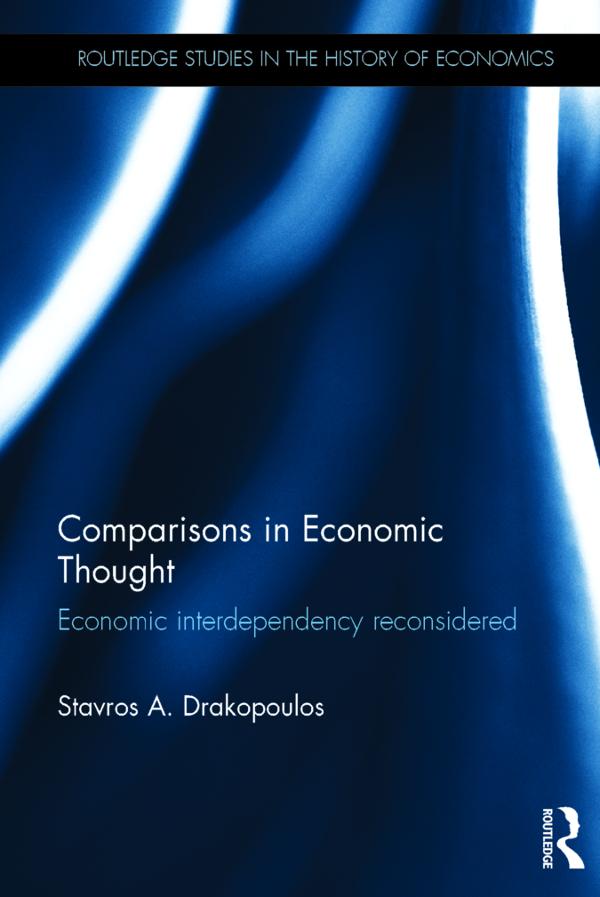
The idea of comparing rewards with others has a long and persistent presence in the social sciences, and can be found in many psychological, social and managerial theories. In economics, this idea can be traced back through the works of a substantial number of eminent thinkers, from Genovesi and Hume, to Smith, Ricardo, Marx, and Mill, through to Veblen, Pigou, and Keynes.
In the last two decades the notion of social comparisons has started to appear more frequently in economic literature, especially in the subfield of happiness research. There are also signs that the notion has resurfaced in some strands of literature such as positional concerns, social identity models and social capital theory. Comparisons in Economic Thought offers a uniquely comprehensive account of how social comparisons have featured in the history of economic thought. This book provides an assessment as to why social comparisons have been dismissed by mainstream economists and considers their current and future usefulness.
This volume is suitable for those who are interested and study history of economic thought, economic methodology and History of Consumer Theory, as well as Rational Choice Theory.
Payez facilement par carte, Klarna, Apple Pay ou Google Pay. Pas satisfait ? Vous avez toujours une garantie de remboursement de 14 jours. En savoir plus dans nos conditions. Si vous avez des questions, envoyez-nous un e-mail à hello@memmo.org.
Memmo facilite tes études, où que tu sois dans le monde. On rassemble tes manuels de cours et des outils d'étude intelligents au même endroit : résumés, quiz, podcasts et flashcards. Et il y a Ted, ton compagnon d'étude qui répond à toutes tes questions. Plus de 50 000 étudiants étudient déjà ici – conçu pour t'aider à apprendre plus vite et à moins stresser.