
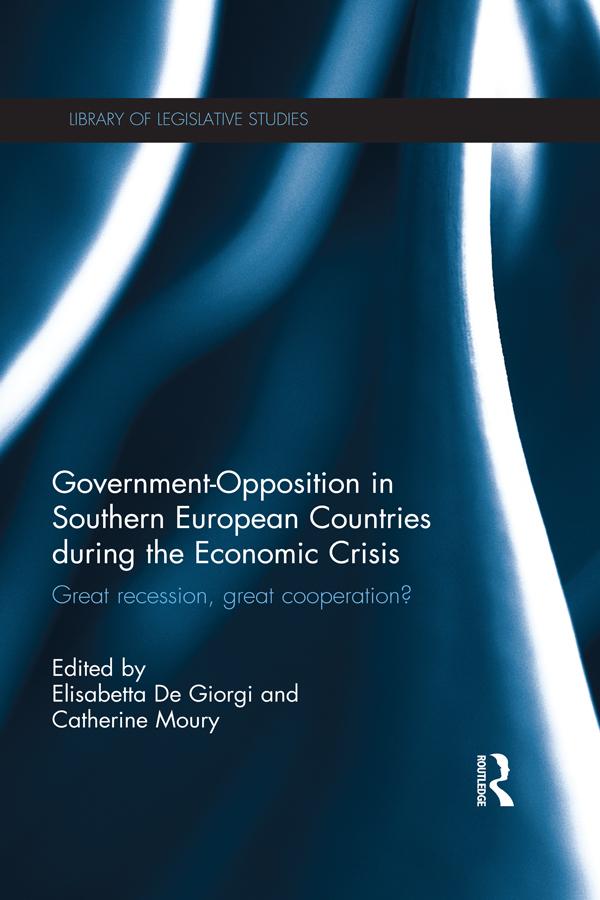
As a result of the financial crisis, opposition parties have had to choose between the need to cooperate with the majority in order to contribute to necessary socio-economic changes, and the opportunity to stress their adversarial position vis-à-vis governments taking radical and unpopular measures.
This book examines how opposition parties address this dilemma. It relies on a qualitative and quantitative analysis of the behaviour of the opposition parties in parliament, in light of the socio-economic issues that have arisen in recent years. It focuses in particular on the impact that the economic malaise has had on the government-opposition dynamics in the four southern European democracies most acutely hit by the crisis: Greece, Italy, Portugal and Spain, as well as in the European Parliament. Each chapter utilizes a combination of empirical data analysis and qualitative process-tracking to understand the opposition parties’ complicated choice between supporting and dissenting.
This book was originally published as a special issue of the Journal of Legislative Studies.
Payez facilement par carte, Klarna, Apple Pay ou Google Pay. Pas satisfait ? Vous avez toujours une garantie de remboursement de 14 jours. En savoir plus dans nos conditions. Si vous avez des questions, envoyez-nous un e-mail à hello@memmo.org.
Memmo facilite tes études, où que tu sois dans le monde. On rassemble tes manuels de cours et des outils d'étude intelligents au même endroit : résumés, quiz, podcasts et flashcards. Et il y a Ted, ton compagnon d'étude qui répond à toutes tes questions. Plus de 50 000 étudiants étudient déjà ici – conçu pour t'aider à apprendre plus vite et à moins stresser.