
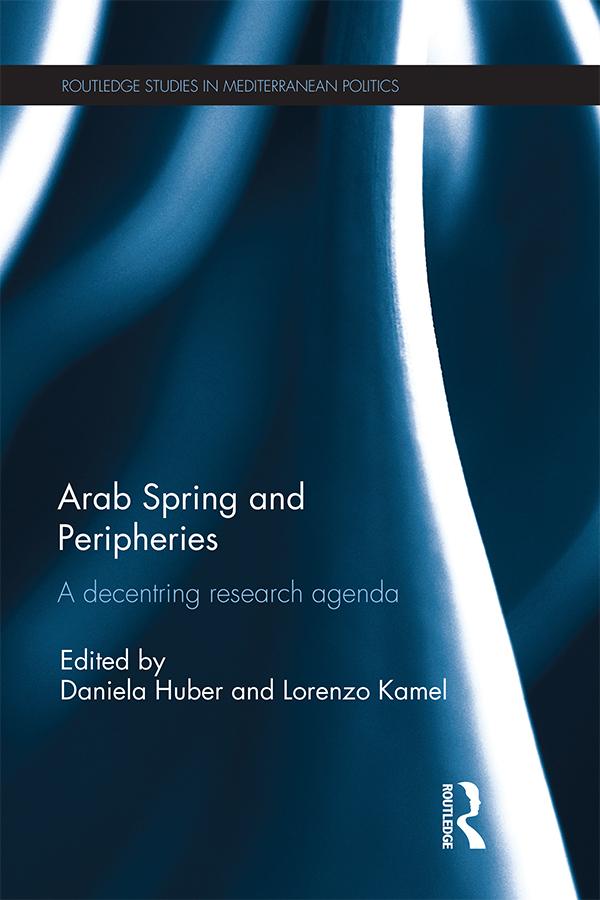
The emerging literature on the so-called ‘Arab Spring’ has largely focused on the evolution of the uprisings in cities and power centres. In order to reach a more diversified and inner understanding of the ‘Arab Spring’, this edited book examines how peripheries have reacted and contributed to the historical dynamics at work in the Middle East and North Africa. It rejects the idea that the ‘Arab Spring’ is a unitary process and shows that it consists of diverse Springs which differed in terms of opportunity structure, strategies of a variance of actors, and outcomes. This book looks at geographical, religious, gender and ethnical peripheries, conceptualizing periphery as a dynamic structure which can expand and contract. It shows that the seeds for changing the face of politics and polities are within peripheries themselves. Focusing on the voices of peripheries can therefore be a powerful tool to ‘de-simplify’ the reading of the Arab Spring and to reshape the paradigmatic schemes through which to look at this part of the world.
This book was published as a special issue of Mediterranean Politics.
Payez facilement par carte, Klarna, Apple Pay ou Google Pay. Pas satisfait ? Vous avez toujours une garantie de remboursement de 14 jours. En savoir plus dans nos conditions. Si vous avez des questions, envoyez-nous un e-mail à hello@memmo.org.
Memmo facilite tes études, où que tu sois dans le monde. On rassemble tes manuels de cours et des outils d'étude intelligents au même endroit : résumés, quiz, podcasts et flashcards. Et il y a Ted, ton compagnon d'étude qui répond à toutes tes questions. Plus de 50 000 étudiants étudient déjà ici – conçu pour t'aider à apprendre plus vite et à moins stresser.