
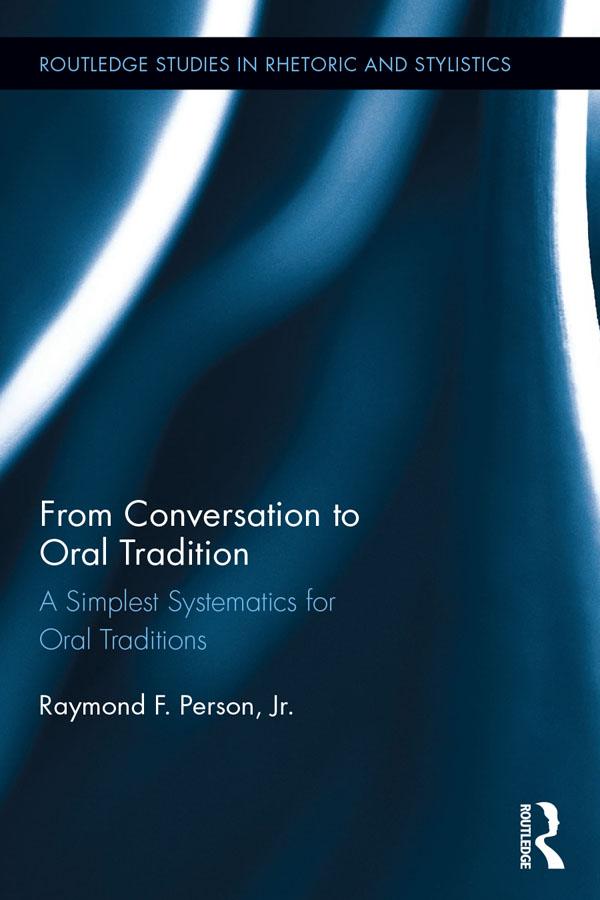
This book argues that many of the most prominent features of oral epic poetry in a number of traditions can best be understood as adaptations or stylizations of conversational language use, and advances the claim that if we can understand how conversation is structured, it will aid our understanding of oral traditions. In this study that carefully compares the "special grammar" of oral traditions to the "grammar" of everyday conversation as understood in the field of conversation analysis, Raymond Person demonstrates that traditional phraseology, including formulaic language, is an adaptation of practices in turn construction in conversation, such as sound-selection of words and prosody, and that thematic structures are adaptations of sequence organization in talk-in-interaction. From this he concludes that the "special grammar" of oral traditions can be understood as an example of institutional talk that exaggerates certain conversational practices for aesthetic purposes and that draws from cognitive resources found in everyday conversation. Person’s research will be of interest to conversation analysts as well as literary scholars, especially those interested in ancient and medieval literature, the comparative study of oral traditions and folklore, and linguistic approaches to literature. This volume lays the groundwork for further interdisciplinary work bridging the fields of literature and linguistics.
Payez facilement par carte, Klarna, Apple Pay ou Google Pay. Pas satisfait ? Vous avez toujours une garantie de remboursement de 14 jours. En savoir plus dans nos conditions. Si vous avez des questions, envoyez-nous un e-mail à hello@memmo.org.
Memmo facilite tes études, où que tu sois dans le monde. On rassemble tes manuels de cours et des outils d'étude intelligents au même endroit : résumés, quiz, podcasts et flashcards. Et il y a Ted, ton compagnon d'étude qui répond à toutes tes questions. Plus de 50 000 étudiants étudient déjà ici – conçu pour t'aider à apprendre plus vite et à moins stresser.