
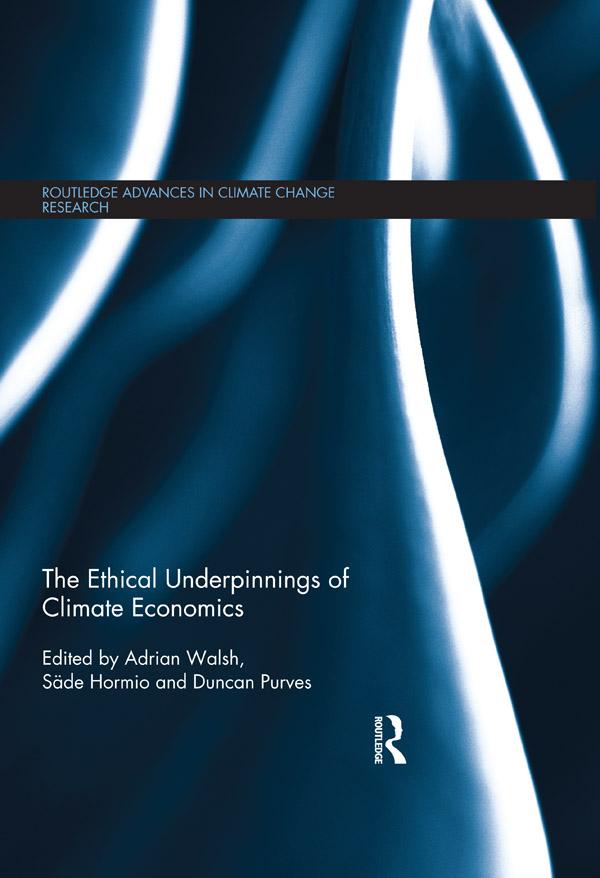
Despite their obvious importance, the ethical implications of climate change are often neglected in economic evaluations of mitigation and adaptation policies. Economic climate models provide estimates of the value of mitigation benefits, provide understanding of the costs of reducing emissions, and develop tools for making policy choices under uncertainty. They have thus offered theoretical and empirical instruments for the design and implementation of a range of climate policies, but the ethical assumptions included in the calculations are usually left unarticulated.
This book, which brings together scholars from both economics and ethical theory, explores the interrelation between climate ethics and economics. Examining a wide range of topics including sustainability, conceptions of value, risk management and the monetization of harm, the book will explore the ethical limitations of economic analysis but will not assume that economic theory cannot accommodate the concerns raised. The aim in part is to identify ethical shortcomings of economic analysis and to propose solutions. Given the on-going role of economics in government thinking on mitigation, a constructive approach is vital if we are to deal adequately with climate change.
This volume will be of great interest to students and scholars of environmental ethics, economics, political science, political philosophy and the philosophy of economics.
Payez facilement par carte, Klarna, Apple Pay ou Google Pay. Pas satisfait ? Vous avez toujours une garantie de remboursement de 14 jours. En savoir plus dans nos conditions. Si vous avez des questions, envoyez-nous un e-mail à hello@memmo.org.
Memmo facilite tes études, où que tu sois dans le monde. On rassemble tes manuels de cours et des outils d'étude intelligents au même endroit : résumés, quiz, podcasts et flashcards. Et il y a Ted, ton compagnon d'étude qui répond à toutes tes questions. Plus de 50 000 étudiants étudient déjà ici – conçu pour t'aider à apprendre plus vite et à moins stresser.