
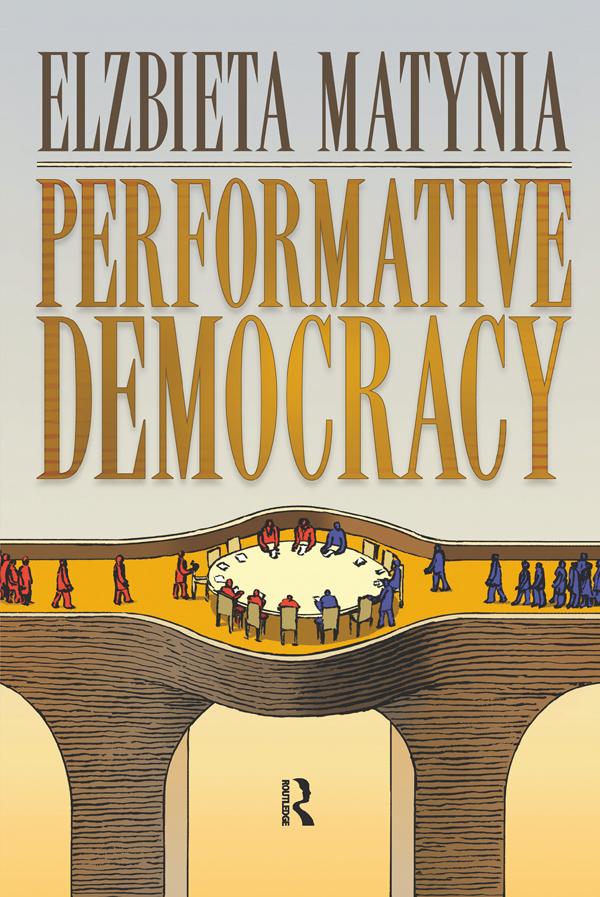
fresh appreciation of the events of 1989 as we approach their 20th anniversary in 2009 Performative Democracy explores a potential in political life that easily escapes theorists: the indigenously inspired enacting of democracy by citizens. Written by one who experienced an emerging public sphere within Communist Poland, the book seeks to identify the conditions for performativity-performing politics--in public life. It examines a broad spectrum of cultural, social, and political initiatives that facilitated the non-violent transformation of an autocratic environment into a democratic one. Examples of performativity range from experimental student theater, through the engaged political thinking of dissident Adam Michnik, the alternative culture, and the Solidarity movement, to the drama of the Round Table Talks (and their striking parallels in South Africa), and finally, the post-1989 efforts of feminist groups and women artists to defend the recently won right of free public discourse. The book argues that performative democracy, with its improvisational mode and imaginative solutions, deserves a legitimate place in our broader reflections on democracy. Matynia describes how two apparent miracles of recent history-that communism in Poland was brought down without violence and that apartheid in South Africa was ended without a bloodbath-were the results of hard work and a new approach to change that she calls "performative democracy." Matynia reveals amazing parallels between the drama of Poland's Round Table Talks in 1989 and the Truth Commissions in South Africa in 1994. Matynia describes how experimental student theater groups, though subsidized by a totalitarian regime afraid of any authentic public life, created little pockets of public space for free and meaningful expression that were augmented by uncensored underground publishing and further expanded by the Solidarity movement into a democratic society within the totalitarian state. Matynia describes in a personal way how in the 1970s student theater groups planted the seeds of an authentic public sphere, how underground publishers nurtured freedom of expression and social criticism, and how, after democratic elections, women artists in the 1990s fought to sustain the newly won right to free public discourse. Matynia traces in vivid human terms the democratic aspirations and practices that led to democratic change in Poland but went largely unnoticed by western media and policymakers.
Payez facilement par carte, Klarna, Apple Pay ou Google Pay. Pas satisfait ? Vous avez toujours une garantie de remboursement de 14 jours. En savoir plus dans nos conditions. Si vous avez des questions, envoyez-nous un e-mail à hello@memmo.org.
Memmo facilite tes études, où que tu sois dans le monde. On rassemble tes manuels de cours et des outils d'étude intelligents au même endroit : résumés, quiz, podcasts et flashcards. Et il y a Ted, ton compagnon d'étude qui répond à toutes tes questions. Plus de 50 000 étudiants étudient déjà ici – conçu pour t'aider à apprendre plus vite et à moins stresser.
Tu pourrais aussi aimer
Acheter le livre0