
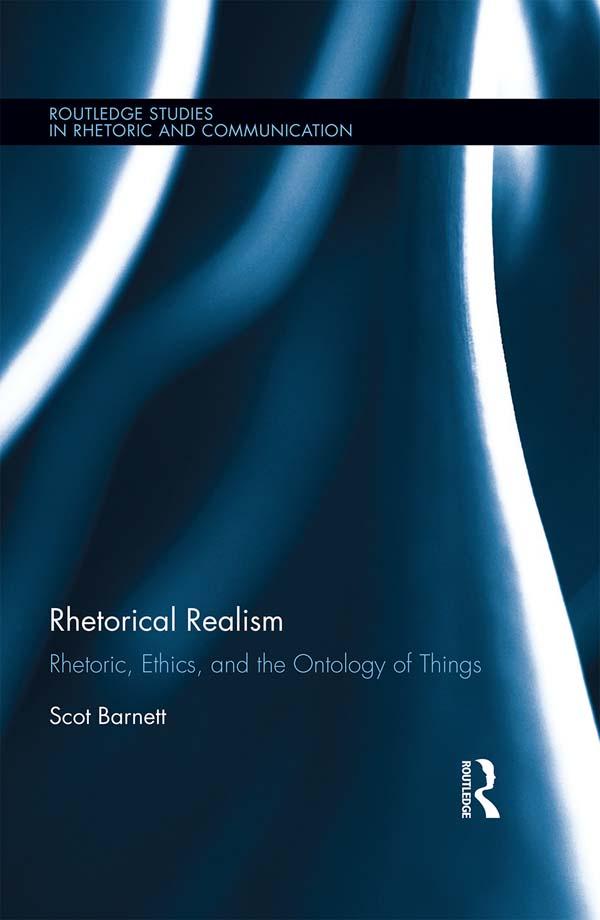
Rhetorical Realism responds to the surging interest in nonhumans across the humanities by exploring how realist commitments have historically accompanied understandings of rhetoric from antiquity to the present. For a discipline that often defines itself according to human speech and writing, the nonhuman turn poses a number of challenges and opportunities for rhetoric. To date, many of the responses to the nonhuman turn in rhetoric have sought to address rhetoric’s compatibility with new conceptions of materiality. In Rhetorical Realism, Scot Barnett extends this work by transforming it into a new historiographic methodology attuned to the presence and occlusion of things in rhetorical history. Through investigations of rhetoric’s place in Aristotelian metaphysics, the language invention movement of the seventeenth century, and postmodern conceptions of rhetoric as an epistemic art, Barnett’s study expands the scope of rhetorical inquiry by showing how realist ideas have worked to frame rhetoric’s scope and meanings during key moments in its history. Ultimately, Barnett argues that all versions of rhetoric depend upon some realist assumptions about the world. Rather than conceive of the nonhuman as a dramatic turning point in rhetorical theory, Rhetorical Realism encourages rhetorical theorists to turn another eye toward what rhetoricians have always done—defining and configuring rhetoric within a broader ontology of things.
Payez facilement par carte, Klarna, Apple Pay ou Google Pay. Pas satisfait ? Vous avez toujours une garantie de remboursement de 14 jours. En savoir plus dans nos conditions. Si vous avez des questions, envoyez-nous un e-mail à hello@memmo.org.
Memmo facilite tes études, où que tu sois dans le monde. On rassemble tes manuels de cours et des outils d'étude intelligents au même endroit : résumés, quiz, podcasts et flashcards. Et il y a Ted, ton compagnon d'étude qui répond à toutes tes questions. Plus de 50 000 étudiants étudient déjà ici – conçu pour t'aider à apprendre plus vite et à moins stresser.