
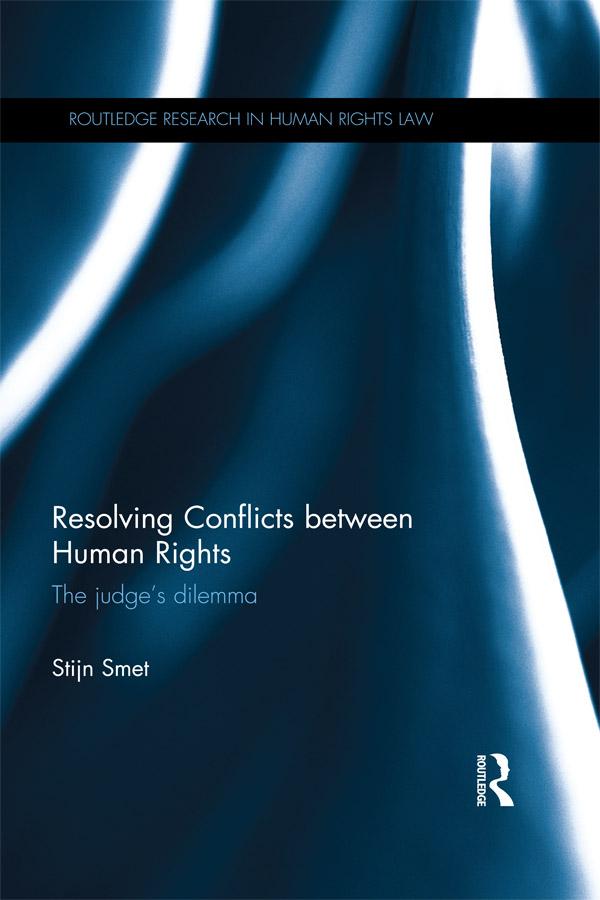
Under the influence of the global spread of human rights, legal disputes are increasingly framed in human rights terms. Parties to a legal dispute can often invoke human rights norms in support of their competing claims. Yet, when confronted with cases in which human rights conflict, judges face a dilemma. They have to make difficult choices between superior norms that deserve equal respect. In this high-level book, the author sets out how judges the world over could resolve conflicts between human rights. He presents an innovative legal theoretical account of such conflicts, questioning the relevance of the influential proportionality test to their resolution. Instead, the author develops a novel resolution framework, specifically designed to tackle human rights conflicts. The book combines concerted normative theory with profound practical analysis, firmly rooting its theoretical arguments in human rights practice. Although the analysis draws primarily on the case law of the European Court of Human Rights, the book’s core arguments are applicable to judicial practice in general. As such, the book should be of great interest to academics, postgraduate students and legal practitioners in Europe and beyond. The book is particularly suited for use in advanced courses on legal theory, human rights law and jurisprudence.
Payez facilement par carte, Klarna, Apple Pay ou Google Pay. Pas satisfait ? Vous avez toujours une garantie de remboursement de 14 jours. En savoir plus dans nos conditions. Si vous avez des questions, envoyez-nous un e-mail à hello@memmo.org.
Memmo facilite tes études, où que tu sois dans le monde. On rassemble tes manuels de cours et des outils d'étude intelligents au même endroit : résumés, quiz, podcasts et flashcards. Et il y a Ted, ton compagnon d'étude qui répond à toutes tes questions. Plus de 50 000 étudiants étudient déjà ici – conçu pour t'aider à apprendre plus vite et à moins stresser.