
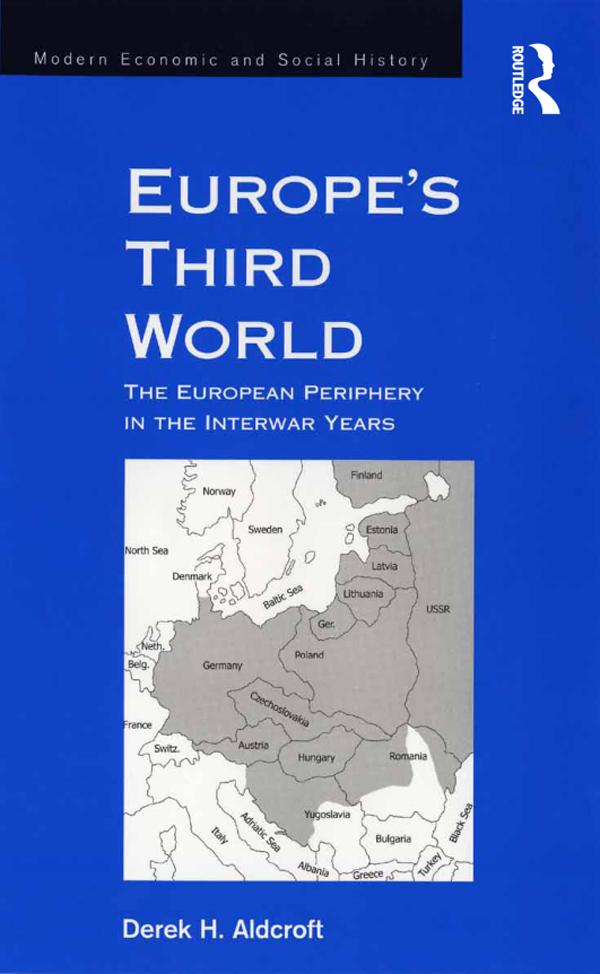
Economic historians have perennially addressed the intriguing question of comparative development, asking why some countries develop much faster and further than others. Focusing primarily on Europe between 1914 and 1939, this present volume explores the development of thirteen countries that could be said to be categorised as economically backward during this period: Albania, Bulgaria, Estonia, Greece, Hungary, Latvia, Lithuania, Poland, Portugal, Romania, Spain, Turkey and Yugoslavia. These countries are linked, not only in being geographically on Europe's periphery, but all shared high agrarian components and income levels much lower than those enjoyed in western European countries. The study shows that by 1918 many of these countries had structural characteristics which either relegated them to a low level of development or reflected their economic backwardness, characteristics that were not helped by the hostile economic climate of the interwar period. It explores, region by region, how their progress was checked by war and depression, and how the effects of political and social factors could also be a major impediment to sustained progress and modernisation. For example, in many cases political corruption and instability, deficient administrations, ethnic and religious diversity, agrarian structures and backwardness, population pressures, as well as international friction, were retarding factors. In all this study offers a fascinating insight into many areas of Europe that are often ignored by economists and historians. It demonstrates that these countries were by no means a lost cause, and that their post-war performances show the latent economic potential that most harboured. By providing an insight into the development of Europe's 'periphery' a much more rounded and complete picture of the continent as a whole is achieved.
Payez facilement par carte, Klarna, Apple Pay ou Google Pay. Pas satisfait ? Vous avez toujours une garantie de remboursement de 14 jours. En savoir plus dans nos conditions. Si vous avez des questions, envoyez-nous un e-mail à hello@memmo.org.
Memmo facilite tes études, où que tu sois dans le monde. On rassemble tes manuels de cours et des outils d'étude intelligents au même endroit : résumés, quiz, podcasts et flashcards. Et il y a Ted, ton compagnon d'étude qui répond à toutes tes questions. Plus de 50 000 étudiants étudient déjà ici – conçu pour t'aider à apprendre plus vite et à moins stresser.
Tu pourrais aussi aimer
Acheter le livre0