
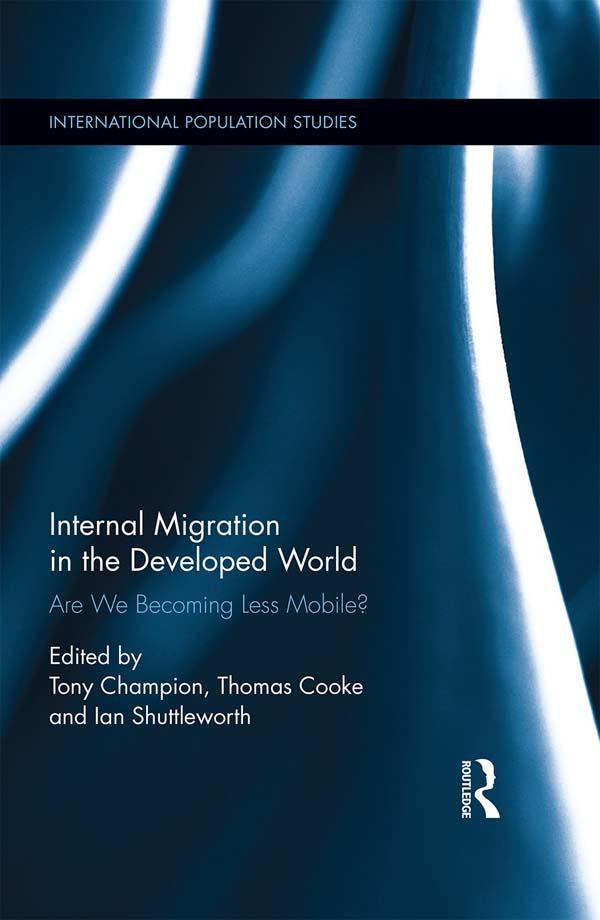
The frequency with which people move home has important implications for national economic performance and the well-being of individuals and families. Much contemporary social and migration theory posits that the world is becoming more mobile, leading to the recent ‘mobilities turn’ within the social sciences. Yet, there is mounting evidence to suggest that this may not be true of all types of mobility, nor apply equally to all geographical contexts. For example, it is now clear that internal migration rates have been falling in the USA since at least the 1980s. To what extent might this trend be true of other developed countries?
Drawing on detailed empirical literature, Internal Migration in the Developed World examines the long-term trends in internal migration in a variety of more advanced countries to explore the factors that underpin these changes. Using case studies of the USA, UK, Australia, Japan, Sweden, Germany and Italy, this pioneering book presents a critical assessment of the extent to which global structural forces, as opposed to national context, influence internal migration in the Global North.
Internal Migration in the Developed World fills the void in this neglected aspect of migration studies and will appeal to a wide disciplinary audience of researchers and students working in Geography, Migration Studies, Population Studies and Development Studies.
Payez facilement par carte, Klarna, Apple Pay ou Google Pay. Pas satisfait ? Vous avez toujours une garantie de remboursement de 14 jours. En savoir plus dans nos conditions. Si vous avez des questions, envoyez-nous un e-mail à hello@memmo.org.
Memmo facilite tes études, où que tu sois dans le monde. On rassemble tes manuels de cours et des outils d'étude intelligents au même endroit : résumés, quiz, podcasts et flashcards. Et il y a Ted, ton compagnon d'étude qui répond à toutes tes questions. Plus de 50 000 étudiants étudient déjà ici – conçu pour t'aider à apprendre plus vite et à moins stresser.