
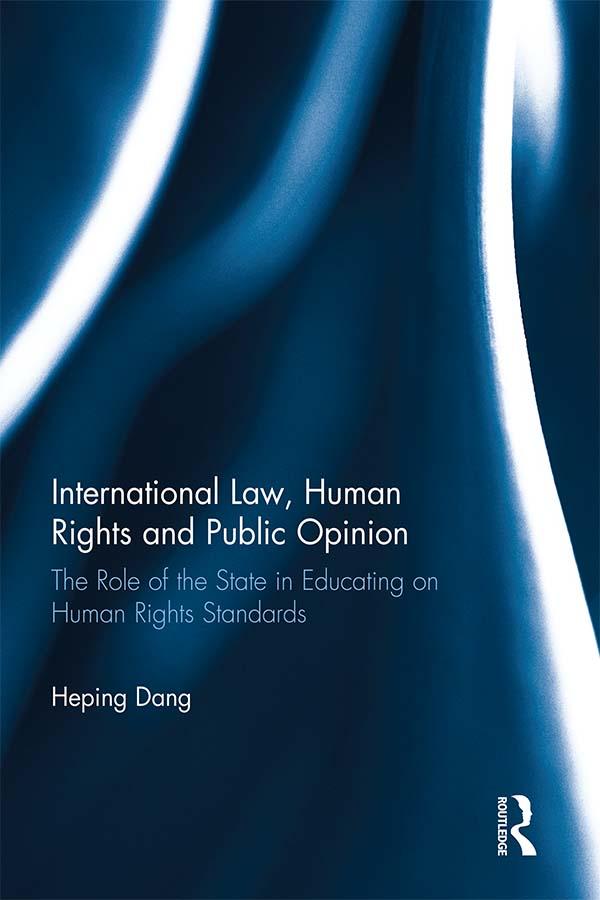
This book explores situations in which public opinion presents itself as an obstacle to the protection and promotion of human rights. Taking an international law perspective, it primarily deals with two questions: first, whether international law requires States to take an independent stance on human rights issues; second, whether international law encourages States to inform and mobilise public opinion with regard to core human rights standards. The discussion is mainly organised within the framework of the UN system. The work is particularly relevant to situations in which public opinion appears as discriminatory attitudes based on race, gender, age, health, sexual orientation and other factors. It is also pertinent to circumstances in which public opinion is responsible for the existence of certain harmful customs and practices such as female genital mutilation and capital punishment. Noting that the death penalty is increasingly recognised as an infringement of human rights, this study further challenges States’ argument that capital punishment cannot be abolished because of public opinion. The book also discusses the role that education bears under international law in moulding favourable attitudes towards human rights. Finally, the book challenges States’ acceptance that public opinion cannot be confronted in this respect.
Payez facilement par carte, Klarna, Apple Pay ou Google Pay. Pas satisfait ? Vous avez toujours une garantie de remboursement de 14 jours. En savoir plus dans nos conditions. Si vous avez des questions, envoyez-nous un e-mail à hello@memmo.org.
Memmo facilite tes études, où que tu sois dans le monde. On rassemble tes manuels de cours et des outils d'étude intelligents au même endroit : résumés, quiz, podcasts et flashcards. Et il y a Ted, ton compagnon d'étude qui répond à toutes tes questions. Plus de 50 000 étudiants étudient déjà ici – conçu pour t'aider à apprendre plus vite et à moins stresser.