
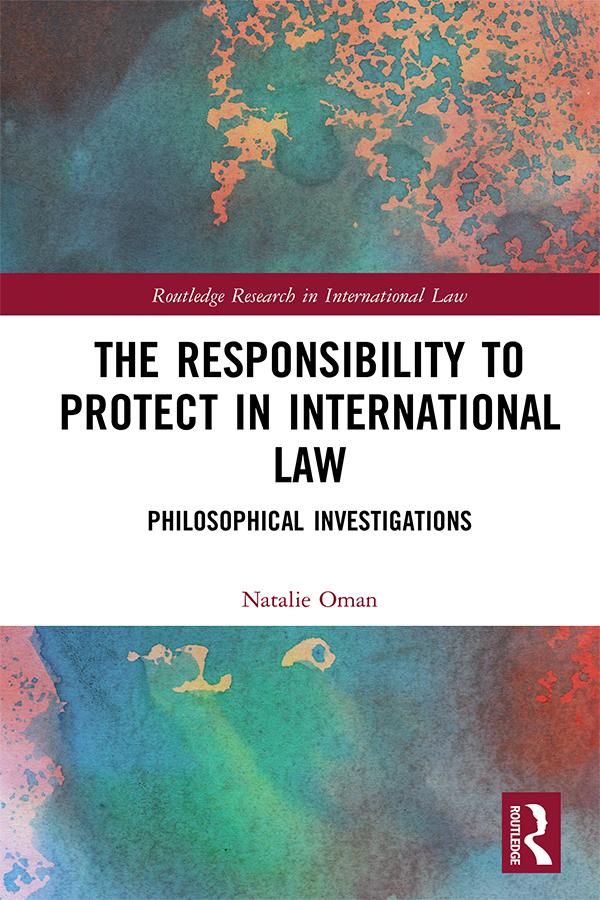
This book tracks the development of the emerging international legal principle of a responsibility to protect over the past two decades. It contrasts the influential version of the principle introduced by the International Commission on Intervention and State Sovereignty in 2001 with subsequent interpretations of the responsibility to protect advocated by the United Nations through its human protection agenda, and reviews the dangers and inconsistencies inherent in both perspectives. The author demonstrates that the evolving responsibility to protect principle can be recruited to support a wide range of irreconcilable projects, from those of cosmopolitan constitutionalism to those of hegemonic international law. However, despite the dangers posed by this susceptibility to conceptual hijacking, Oman argues that the responsibility to protect, like human rights, is an essential a modern emancipatory formation. To remedy this dangerous malleability, the author advocates a third, distinctive interpretation of the responsibility to protect designed to limit its cooptation by liberal anti-pluralist and hegemonic international law agendas. Oman outlines the key features of such a minimalist conception, and explores its fit with the "RtoP" version of the responsibility to protect promoted in recent years by the UN. The author argues that two crucial features missing from the UN reading of the principle should be developed in future: an acknowledgement of the role of non-state actors as bearers of the responsibility to protect, and a recognition of the principle's legal character. Both of these aspects of the principle offer means to democratize the international law-making enterprise.
Payez facilement par carte, Klarna, Apple Pay ou Google Pay. Pas satisfait ? Vous avez toujours une garantie de remboursement de 14 jours. En savoir plus dans nos conditions. Si vous avez des questions, envoyez-nous un e-mail à hello@memmo.org.
Memmo facilite tes études, où que tu sois dans le monde. On rassemble tes manuels de cours et des outils d'étude intelligents au même endroit : résumés, quiz, podcasts et flashcards. Et il y a Ted, ton compagnon d'étude qui répond à toutes tes questions. Plus de 50 000 étudiants étudient déjà ici – conçu pour t'aider à apprendre plus vite et à moins stresser.