
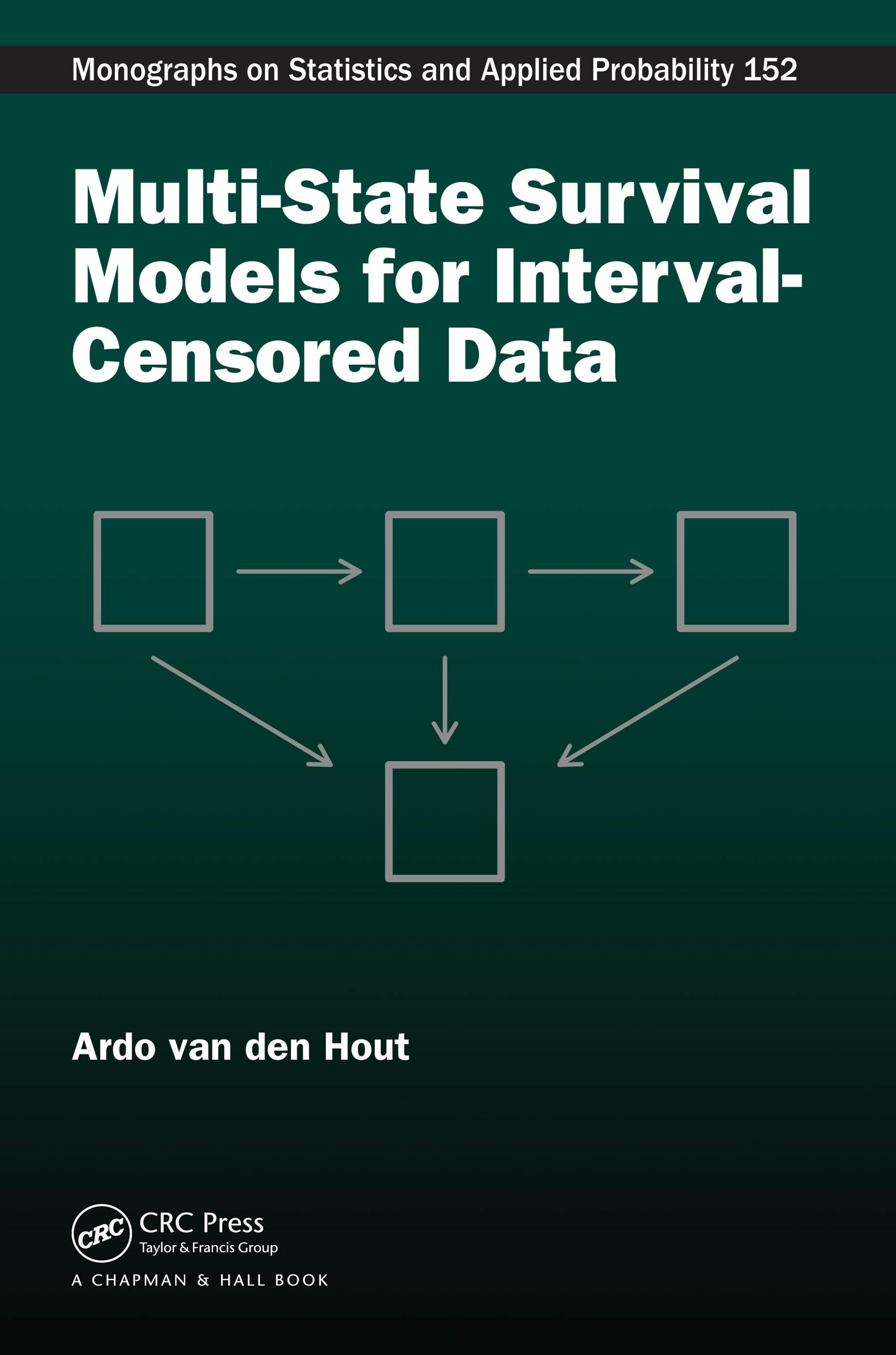
Multi-State Survival Models for Interval-Censored Data introduces methods to describe stochastic processes that consist of transitions between states over time. It is targeted at researchers in medical statistics, epidemiology, demography, and social statistics. One of the applications in the book is a three-state process for dementia and survival in the older population. This process is described by an illness-death model with a dementia-free state, a dementia state, and a dead state. Statistical modelling of a multi-state process can investigate potential associations between the risk of moving to the next state and variables such as age, gender, or education. A model can also be used to predict the multi-state process.
The methods are for longitudinal data subject to interval censoring. Depending on the definition of a state, it is possible that the time of the transition into a state is not observed exactly. However, when longitudinal data are available the transition time may be known to lie in the time interval defined by two successive observations. Such an interval-censored observation scheme can be taken into account in the statistical inference.
Multi-state modelling is an elegant combination of statistical inference and the theory of stochastic processes. Multi-State Survival Models for Interval-Censored Data shows that the statistical modelling is versatile and allows for a wide range of applications.
Payez facilement par carte, Klarna, Apple Pay ou Google Pay. Pas satisfait ? Vous avez toujours une garantie de remboursement de 14 jours. En savoir plus dans nos conditions. Si vous avez des questions, envoyez-nous un e-mail à hello@memmo.org.
Memmo facilite tes études, où que tu sois dans le monde. On rassemble tes manuels de cours et des outils d'étude intelligents au même endroit : résumés, quiz, podcasts et flashcards. Et il y a Ted, ton compagnon d'étude qui répond à toutes tes questions. Plus de 50 000 étudiants étudient déjà ici – conçu pour t'aider à apprendre plus vite et à moins stresser.