
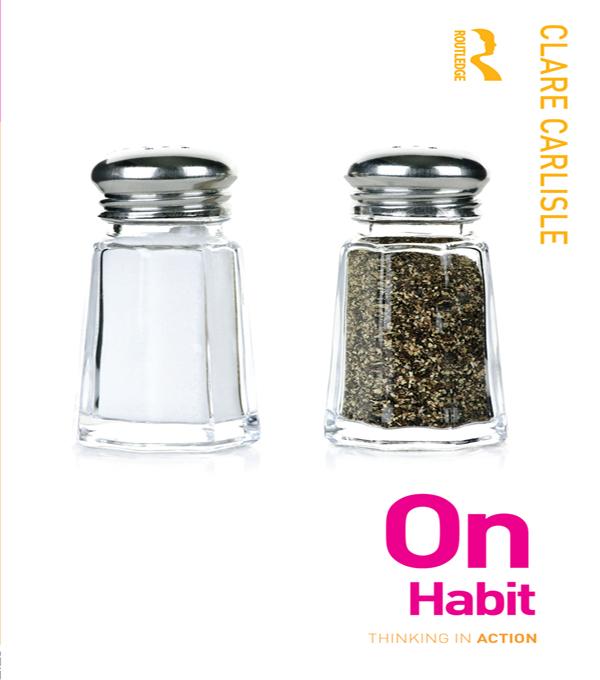
For Aristotle, excellence is not an act but a habit, and Hume regards habit as ‘the great guide of life’. However, for Proust habit is problematic: ‘if habit is a second nature, it prevents us from knowing our first.’
What is habit? Do habits turn us into machines or free us to do more creative things? Should religious faith be habitual? Does habit help or hinder the practice of philosophy? Why do Luther, Spinoza, Kant, Kierkegaard and Bergson all criticise habit? If habit is both a blessing and a curse, how can we live well in our habits?
In this thought-provoking book Clare Carlisle examines habit from a philosophical standpoint. Beginning with a lucid appraisal of habit’s philosophical history she suggests that both receptivity and resistance to change are basic principles of habit-formation. Carlisle shows how the philosophy of habit not only anticipates the discoveries of recent neuroscience but illuminates their ethical significance. She asks whether habit is a reliable form of knowledge by examining the contrasting interpretations of habitual thinking offered by Spinoza and Hume. She then turns to the role of habit in the good life, tracing Aristotle’s legacy through the ideas of Joseph Butler, Hegel, and Félix Ravaisson, and assessing the ambivalent attitudes to habit expressed by Nietzsche and Proust.
She argues that a distinction between habit and practice helps to clarify this ambivalence, particularly in the context of habit and religion, where she examines both the theology of habit and the repetitions of religious life. She concludes by considering how philosophy itself is a practice of learning to live well with habit.
Payez facilement par carte, Klarna, Apple Pay ou Google Pay. Pas satisfait ? Vous avez toujours une garantie de remboursement de 14 jours. En savoir plus dans nos conditions. Si vous avez des questions, envoyez-nous un e-mail à hello@memmo.org.
Memmo facilite tes études, où que tu sois dans le monde. On rassemble tes manuels de cours et des outils d'étude intelligents au même endroit : résumés, quiz, podcasts et flashcards. Et il y a Ted, ton compagnon d'étude qui répond à toutes tes questions. Plus de 50 000 étudiants étudient déjà ici – conçu pour t'aider à apprendre plus vite et à moins stresser.